

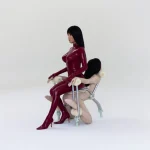
Courtesy of BIO POP by Bianca Censori / @biancacensori; Photo by Noah Dillon / @noahpdillon
In an era when design is often reduced to aesthetics and market trends, Bianca Censori is steering the conversation somewhere far less comfortable — and far more urgent. With her debut exhibition Bio-Pop (The Origin), the Australian architect and designer challenges not only what furniture looks like, but what it does to the body, to identity, and to power.
Presented in Seoul as the first installment of a long-term artistic cycle, Bio-Pop is not simply a furniture collection. It is a staged environment where domestic rituals, sculptural objects, and human bodies merge into a single narrative about control, expectation, and the politics of space.

Furniture as a Living System
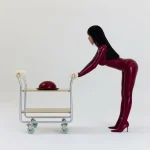
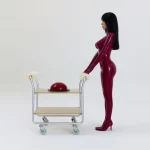
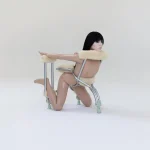
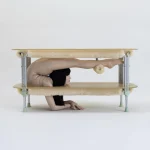
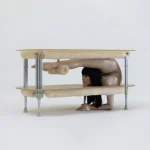
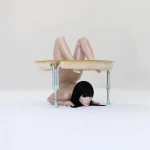
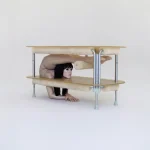
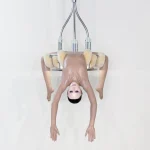
Censori’s pieces — chairs, tables, a chandelier, and a bar cart — initially read as experimental design objects. Constructed from steel, resin, plexiglass, and tactile upholstery, they hover between industrial precision and surreal softness. Yet the forms are intentionally disquieting. They echo medical apparatuses and support structures, blurring the line between comfort and confinement.
This is where Bio-Pop shifts from design into commentary.
Rather than treating furniture as passive décor, Censori positions it as an active force — something that shapes posture, behavior, and even identity. The domestic interior becomes less a backdrop and more a system of quiet discipline. A chair is no longer just a place to sit; it becomes a device that instructs the body how to exist.

Performance in the Domestic Sphere
What intensified the impact of Bio-Pop was Censori’s decision to stage it as a live performance. Moving through the space in a latex bodysuit, she enacted repetitive household tasks — baking, serving, arranging. The gestures were mechanical, stripped of warmth. Familiar rituals of domestic life felt choreographed, almost programmed.
By repeating these acts in a hyper-stylized environment, Censori exposes how the domestic sphere can operate as both sanctuary and stage — a place where roles are performed, often unconsciously. The body becomes another design element, conditioned by its surroundings.
In some moments, performers interacted directly with the furniture, dissolving the distinction between object and person. This collapse is central to Bio-Pop’s message: the body and the built environment are not separate entities. They co-produce one another.

Feminism Through Form
Censori’s work enters a lineage of feminist artists who have interrogated the domestic interior as a site of power. However, her approach feels distinctly contemporary. Rather than relying on overt symbolism, she embeds critique into materiality and ergonomics.
The padded surfaces, sculptural restraints, and medical references are deliberate. They suggest histories of bodily regulation — particularly of women’s bodies — without resorting to literal storytelling. Even her accompanying jewelry collection, inspired by clinical instruments, reframes tools of discomfort as objects of adornment, complicating narratives of vulnerability and agency.
Importantly, Bio-Pop does not present easy answers. It resists moral clarity. Is it critique, provocation, or aesthetic experiment? Perhaps it is all three.

The Tension Between Empowerment and Spectacle
As with much boundary-pushing work, Bio-Pop has sparked debate. Some viewers interpret it as a bold feminist statement about the architecture of control. Others question whether the imagery risks reproducing the dynamics it seeks to dismantle.
This tension may be precisely the point.
Censori seems less interested in offering a manifesto and more invested in creating friction — forcing audiences to confront their own assumptions about design, gender, and spectacle. In doing so, she repositions furniture as a cultural artifact loaded with ideology.

A New Direction for Design Discourse
What makes Bio-Pop particularly relevant today is its refusal to separate design from social commentary. In a design culture often obsessed with minimalism and marketability, Censori pushes toward discomfort. She suggests that interiors are never neutral. They script behavior. They encode expectations. They quietly teach us how to move, sit, host, and exist.
By merging architecture, furniture, performance, and body politics, Bianca Censori expands the definition of what a designer can be. Bio-Pop is not simply a collection of objects; it is a proposition: that the spaces we inhabit are inseparable from the systems that shape us.
Whether celebrated or contested, her work demands attention. And perhaps that is its greatest success — reminding us that design is never just about form. It is about power, presence, and the bodies that move within it.


Related Article:
Vantara: Inside global wildlife rescue, care and conservation centre
AI in Architecture: Redefining Creativity and Efficiency
Hostile Architecture in India: Urban beauty at the cost of humanity
Experts share simple Vastu principles to fill your home with positive energy and peace
The modern evolution of office interior design: Creating workspaces that inspire productivity
Kinetic Facades: The Future of Sustainable Architecture
Industrial Style: How to Achieve it in Your Home?