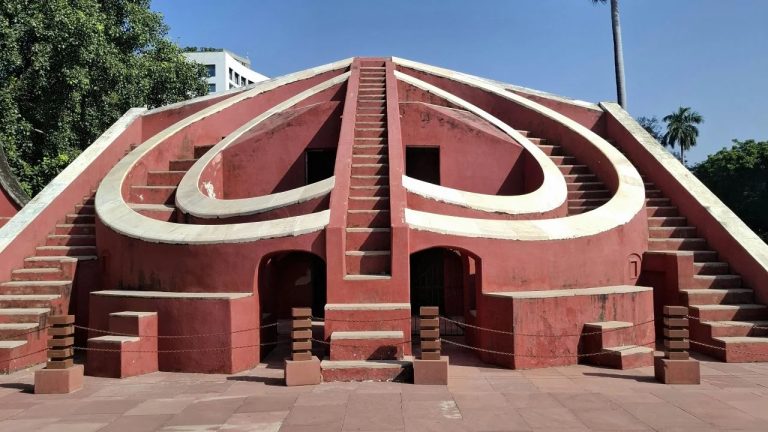
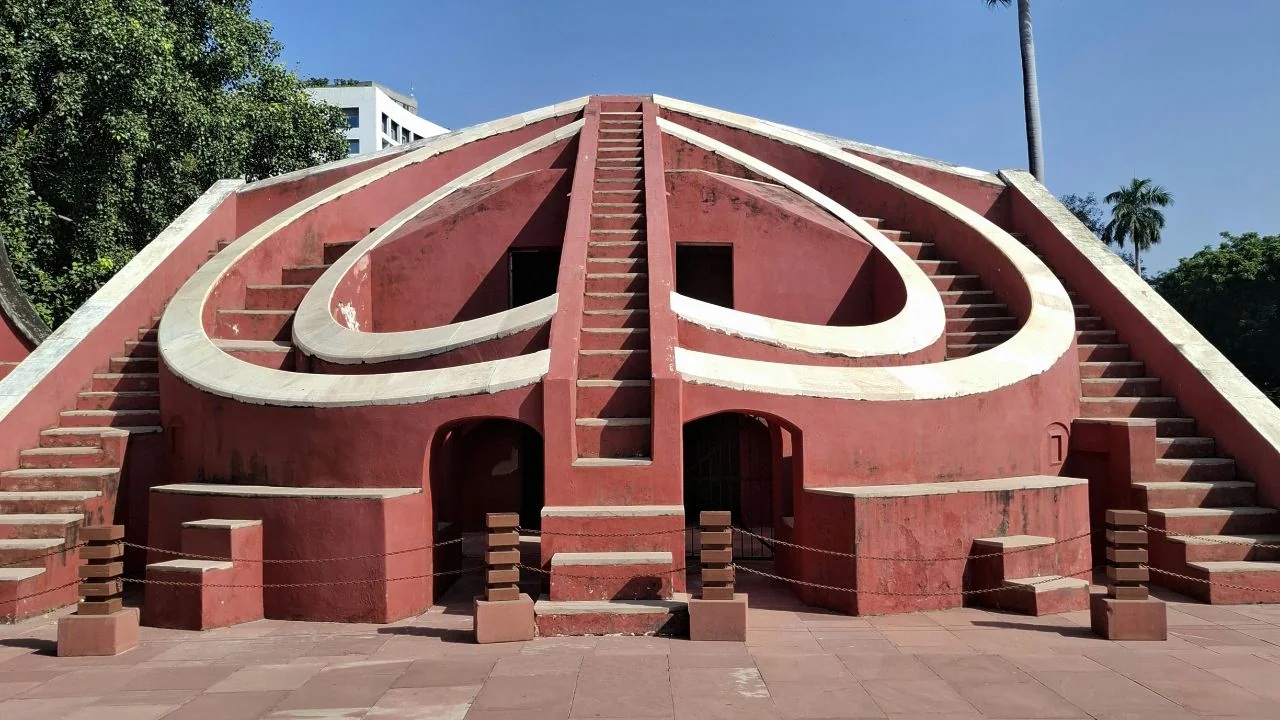
Exploring the extraordinary 18th-century observatory that transformed scientific instruments into monumental architecture.
There are buildings that shelter us, buildings that inspire us, and then there are structures that change the way we understand the world around us. Jantar Mantar belongs to the third category. At first glance, its massive geometric forms may appear abstract, almost like contemporary sculptural installations placed within an open courtyard. Look a little closer, however, and a remarkable story begins to unfold—one of astronomy, mathematics, craftsmanship, and architectural innovation.
Built in the early 18th century, Jantar Mantar represents a time when scientific observation relied on careful calculation, direct engagement with the natural world, and an extraordinary understanding of geometry. Its monumental instruments were designed to study the movement of celestial bodies, measure time, and track the positions of the Sun, Moon, and stars.
For architects and design enthusiasts, Jantar Mantar is particularly fascinating because it blurs the conventional boundaries between architecture, science, and art. The structures are not simply buildings housing instruments; the architecture itself is the instrument.
Although the name Jantar Mantar is commonly associated with the observatory in Jaipur, the historic observatories built by Maharaja Sawai Jai Singh II also include sites in Delhi, Ujjain, Varanasi, and Mathura. Among these, the Jaipur observatory is especially significant for its scale, collection of instruments, and exceptional state of preservation.
The Story Behind Jantar Mantar
To understand Jantar Mantar, it is important to look at the person who envisioned it: Maharaja Sawai Jai Singh II, the ruler of Amber and the founder of Jaipur.
Jai Singh II was deeply interested in astronomy and mathematics. During his reign, he recognised the need for more reliable astronomical observations and improved calculations. Existing instruments, including smaller metal instruments, had limitations when it came to making certain precise measurements. His response was ambitious: instead of relying exclusively on portable instruments, he commissioned enormous fixed structures built on the ground.
These observatories were designed to make astronomical observations more practical and systematic. They also brought together knowledge from different intellectual traditions, including Indian, Islamic, and European astronomical literature.
The Jaipur observatory was developed between 1728 and 1734 and became one of the most sophisticated achievements of its kind in the region.
Key facts:
- Location: Jaipur, Rajasthan, India
- Built by: Maharaja Sawai Jai Singh II
- Construction period: 1728–1734
- Purpose: Astronomical observation and time measurement
- UNESCO status: World Heritage Site since 2010
- Number of instruments: 19 principal instruments
- Famous instrument: Samrat Yantra, a monumental sundial
- Other notable instruments: Jai Prakash Yantra and Ram Yantra
- Architectural style: Geometric, scientific, and monumental
- Materials used: Stone, masonry, plaster, and marble
- Scientific significance: Studies celestial positions, solar time, and astronomical movements
- Architectural significance: Demonstrates the integration of mathematics, astronomy, and architecture
- Related observatories: Delhi, Jaipur, Ujjain, Varanasi, and Mathura
- Key design feature: Structures designed as functional astronomical instruments rather than conventional buildings
Architecture That Measures the Sky
One of the most striking aspects of Jantar Mantar is its unusual architectural language. Unlike traditional palaces, temples, or monumental gateways, its structures do not primarily serve a conventional enclosed space. Instead, their forms are determined by the scientific tasks they were designed to perform.
Curved walls, enormous triangular planes, graduated surfaces, circular arrangements, and carefully positioned openings create a landscape of geometric forms. Every major element has a purpose, whether it is to cast a shadow, align with a celestial reference, or help determine an angular measurement.
The result is an architectural composition that feels both highly rational and visually expressive.
Key architectural features
- Geometry as the starting point: The forms of the instruments are based on mathematical principles. Triangles, circles, arcs, planes, and angular relationships are not merely decorative choices; they are essential to their function.
- Monumental scale: Many instruments are significantly larger than their portable counterparts. Their dimensions were intended to facilitate observations and readings, although precision also depended on calibration, construction quality, and observational conditions.
- Open-to-sky planning: The instruments occupy an outdoor setting, allowing direct observation of sunlight and the visible sky. The absence of conventional roofs over the main instruments is fundamental to their purpose.
- Orientation and alignment: The positioning of the instruments relates to astronomical reference points, the Earth’s rotation, and the apparent movement of celestial bodies.
- Material and construction: Masonry, stone, plaster, and marble were used to create durable forms with precisely defined edges, curves, and measurement markings.
- Movement through space: Visitors experience the observatory as a sequence of distinct structures. Moving between them reveals different relationships between geometry, light, shadow, and scale.
From an architectural perspective, the most important lesson is that form follows a purpose far beyond aesthetics. Each structure emerges from a specific scientific requirement, yet the collection as a whole possesses a striking visual identity.
The Instruments: Understanding the Science Behind the Forms
To appreciate Jantar Mantar fully, it helps to understand what its principal instruments were designed to do. Each one approaches the observation of the sky differently, translating astronomical principles into a physical arrangement that can be read and interpreted.
1. Samrat Yantra: The Giant Sundial
The Samrat Yantra is among the most recognisable structures at Jantar Mantar. Its monumental triangular gnomon rises above graduated quadrants, creating an imposing composition of sloping planes and curved surfaces.
The instrument functions as an equinoctial sundial. Its central structure is aligned parallel to the Earth’s rotational axis, while its shadow moves across the calibrated surfaces as the Sun appears to travel across the sky.
Key facts:
- It is used to determine local solar time.
- Its triangular gnomon and graduated surfaces translate the Sun’s apparent movement into measurable intervals.
- The Jaipur observatory’s Vrihat Samrat Yantra is particularly notable for its immense scale.
- Its design demonstrates how a simple natural phenomenon—the movement of a shadow—can be translated into a sophisticated measuring system.
For architects, the Samrat Yantra is a compelling example of how structural form, orientation, and light can work together to produce a functional instrument.
2. Jai Prakash Yantra: Reading the Sky Through a Hemisphere
The Jai Prakash Yantra takes a very different approach. Rather than rising above the ground as a solid geometric mass, it uses a concave, bowl-like surface marked with a network of lines.
The instrument represents a section of the celestial sphere. Through its markings and observational arrangements, users could determine the positions of celestial bodies and relate them to astronomical coordinates.
Key facts:
- Its bowl-shaped form is based on the geometry of the celestial sphere.
- Its markings correspond to celestial reference lines and coordinate systems.
- It was used to help determine the positions of astronomical objects.
- Its form demonstrates how a complex three-dimensional model of the sky can be represented through architectural geometry.
The Jai Prakash Yantra is especially interesting because the observer engages with the instrument from within its spatial arrangement. The sky is not merely viewed from a distance; its geometry is translated into a physical surface.
3. Ram Yantra: Measuring Altitude and Direction
The Ram Yantra comprises cylindrical arrangements that help observers determine the altitude and azimuth of celestial bodies. These measurements describe, respectively, how high an object appears above the horizon and its direction around the horizon.
Key facts:
- It was designed to measure the horizontal coordinates of celestial objects.
- Its cylindrical geometry and central observational arrangements work together with marked surfaces.
- It demonstrates the practical use of circular geometry in astronomical measurement.
- Its open structure allows observers to relate the instrument’s markings directly to the sky.
The Ram Yantra illustrates a fundamental principle of instrument design: a complex measurement becomes easier to understand when the physical form is organised around the quantity being measured.
4. Misra Yantra: Comparing Time Across Locations
The Misra Yantra is a distinctive instrument associated with the Delhi Jantar Mantar. Its name is commonly understood as referring to a composite or mixed arrangement, reflecting the combination of different observational elements.
Key facts:
- It combines multiple components for different astronomical calculations.
- It was used for tasks including determining certain solar events and comparing local times.
- Its layout demonstrates how several scientific functions can be brought together within one architectural composition.
- It is an important example of the diversity of instruments found across Jai Singh II’s observatories.
It is worth noting that not every instrument bearing a similar name appears at every Jantar Mantar site. The Delhi and Jaipur observatories have different collections and arrangements, making each site distinct.
Jantar Mantar and the Relationship Between Science and Architecture
Jantar Mantar offers a valuable perspective on a question that continues to interest architects today: can a structure be both an instrument and a work of architecture?
At this observatory, the answer is clearly yes.
The instruments are functional, but their geometry also creates an extraordinary spatial experience. Their scale gives them a monumental presence, while their carefully calculated shapes establish a visual order across the site.
This relationship can be understood through several architectural principles.
Key design lessons from Jantar Mantar
- Function can generate form: Rather than beginning with a visual style, the design responds to scientific requirements. The resulting forms are distinctive because they emerge from purpose.
- Geometry can organise space: Mathematical relationships determine not only the instruments’ individual shapes but also how they are positioned and understood within the observatory.
- Light can become a design material: Sunlight and shadow are active components of the instruments. They help produce measurements and make the passage of time visible.
- Scale can improve legibility: The monumental dimensions of the instruments create a physical setting in which otherwise abstract astronomical concepts can be observed and studied.
- Precision and beauty can coexist: The structures demonstrate that technical accuracy and visual impact do not need to be opposing objectives.
- Context matters: An observatory depends on its relationship with the sky and its surroundings. Uncontrolled visual obstructions can compromise the conditions needed for observation.
These lessons remain relevant to contemporary architecture, where designers increasingly explore responsive environments, passive systems, material expression, and the relationship between built form and natural phenomena.
Jantar Mantar as a Landscape of Light and Shadow
A visit to Jantar Mantar is also an encounter with the changing character of daylight. Unlike a conventional building, whose appearance may remain relatively stable throughout the day, an astronomical instrument can reveal different visual relationships as the Sun changes position.
Shadows move across calibrated surfaces. Edges become more pronounced under direct sunlight, while curved forms create shifting patterns of contrast. The architecture makes an invisible concept—time—visible through a natural phenomenon.
This quality offers an important lesson for architectural design.
Light is often treated as a way to illuminate a space, but at Jantar Mantar it becomes an active part of the structure’s operation. Its direction and movement are essential to the instrument itself.
Key observations for design enthusiasts:
- The relationship between sunlight and geometry is central to the observatory’s functioning.
- Shadows act as measurable indicators rather than simply visual effects.
- The open setting allows the sky to remain an integral part of the architectural experience.
- The perception of the structures changes with the position of the Sun and the observer’s viewpoint.
- The site demonstrates a direct relationship between natural cycles and the built environment.
In an age when many buildings depend on complex digital systems, Jantar Mantar reminds us that architecture can also engage with natural processes through carefully considered geometry.
The Scientific Significance of Jantar Mantar
Jantar Mantar was not conceived as a decorative monument. It was part of a serious effort to improve astronomical observation and calculation.
Jai Singh II’s scholarly interests brought together astronomical knowledge from different traditions. The observatories supported systematic observations and the preparation of astronomical tables, helping scholars compare calculations with what could be observed in the sky.
The work carried out at these sites formed part of a broader scientific culture in which astronomy, calendrical calculations, and astrology were closely connected.
Key scientific facts
- Astronomical observation: The instruments were designed to observe the positions and apparent movements of celestial bodies.
- Time measurement: Sundials and related instruments helped establish local solar time.
- Celestial coordinates: Certain instruments enabled observers to determine measurements such as altitude, azimuth, and celestial position.
- Mathematical foundations: The instruments depended on geometry, angular measurement, and the relationship between the observer’s location and the celestial sphere.
- Cross-cultural knowledge: The observatories reflect the circulation and adaptation of astronomical ideas across Indian, Islamic, and European scholarly traditions.
- Scientific limitations: The instruments’ accuracy depended on their construction, calibration, the observer’s technique, and the conditions of observation. They should be understood within the scientific context of their time rather than judged solely by the standards of modern telescopic astronomy.
Jantar Mantar is therefore important not only for what it measures, but also for what it reveals about the development of scientific thought in early modern India.
Jantar Mantar and UNESCO World Heritage Recognition
The Jaipur observatory was inscribed on the UNESCO World Heritage List in 2010. Its recognition reflects its exceptional testimony to astronomical knowledge and its unusual combination of scientific purpose and monumental architectural form.
UNESCO highlights the site’s collection of large fixed instruments, its distinctive innovations, and its role in the history of astronomical observation.
The designation also recognises the observatory as an expression of a period when scientific knowledge, royal patronage, cosmological beliefs, and urban identity were closely connected.
Why the Jaipur observatory is significant:
- It preserves an exceptional collection of monumental astronomical instruments.
- Some instruments are among the largest surviving examples of their type.
- It documents a sophisticated tradition of naked-eye astronomical observation.
- It demonstrates how scientific practices can shape an architectural ensemble.
- It provides evidence of the exchange of knowledge across different cultural and scholarly traditions.
The UNESCO designation applies specifically to the Jantar Mantar in Jaipur. The observatory in Delhi and the other related sites have their own histories and heritage significance.
Conservation: Protecting Architecture That Depends on Its Environment
Historic observatories face a particular conservation challenge. Their significance lies not only in the physical structures but also in their relationship with the surrounding environment.
For Jantar Mantar, preserving masonry, plaster, measurement markings, and structural surfaces is essential. Equally important is protecting the setting in which the instruments operate and can be understood.
The Jaipur observatory has undergone restoration and maintenance over time. UNESCO has also identified the management of tourism and surrounding urban development as important considerations for protecting the site’s heritage values.
Key conservation considerations
- Material preservation: Stone, plaster, masonry, and graduated surfaces require appropriate maintenance to prevent deterioration.
- Accuracy of markings: Measurement scales and instrument details must be protected because they are integral to the structures’ scientific meaning.
- Environmental exposure: As an outdoor monument, the observatory is affected by weather, moisture, heat, and other environmental conditions.
- Visual integrity: The relationship between the instruments, open sky, and surrounding urban landscape contributes to the site’s significance.
- Visitor management: Tourism must be balanced with the protection of fragile surfaces and the quality of the visitor experience.
- Evidence-based restoration: Conservation interventions should respect the historic fabric and rely on specialist research rather than altering structures for visual effect alone.
For architects and conservation professionals, Jantar Mantar underlines an essential principle: heritage protection is not simply about keeping old structures standing. It is also about preserving the relationships, knowledge, and environmental conditions that give those structures meaning.
Visiting Jantar Mantar: What Should Architecture Enthusiasts Look For?
Whether visiting the Jaipur observatory or the Delhi site, it helps to approach Jantar Mantar with curiosity rather than treating it as a collection of unusual monuments.
Take time to understand how each instrument works, how it is oriented, and how its markings relate to the sky. The experience becomes far more rewarding when the geometry is understood as a practical response to a scientific problem.
Things to observe during a visit:
- Look at the relationship between the instrument’s overall geometry and its specific purpose.
- Notice how shadows interact with the surfaces and measurement markings.
- Compare the scale of the structures with the smaller instruments traditionally used for astronomical observation.
- Observe how movement through the site reveals different alignments, profiles, and spatial relationships.
- Read the interpretation panels to understand the scientific function of individual instruments.
- Consider how the surrounding city influences the experience and, in some cases, the conditions required for astronomical observation.
The Jaipur and Delhi observatories should not be treated as identical. Each contains different instruments and reflects its own architectural and historical context.
What Contemporary Architecture Can Learn from Jantar Mantar
Jantar Mantar’s relevance extends beyond heritage conservation. Its underlying design principles remain valuable in contemporary architectural practice.
Today, architects explore parametric geometry, environmental responsiveness, passive design, and the integration of technology into built form. Jantar Mantar demonstrates that many of these concerns have long histories, even if the methods and technologies have changed.
Its instruments respond directly to the movement of the Sun and the geometry of the sky. Their performance is inseparable from their form, orientation, and setting.
For contemporary designers, the observatory offers several enduring lessons:
- Design with a clear purpose: Begin with the problem a structure must solve, and allow that requirement to inform its form.
- Make natural processes visible: Architecture can reveal sunlight, shadow, movement, and time instead of treating them as background conditions.
- Use geometry meaningfully: Mathematical systems can provide both functional clarity and a strong architectural identity.
- Respect the site: A structure may depend on its landscape, orientation, or relationship with the sky. Design should account for these conditions from the beginning.
- Combine technical knowledge with experience: A building or structure can communicate complex ideas through direct physical interaction.
- Think beyond the object: The observatory’s value lies in the relationships between its instruments, their users, the sky, and the surrounding city.
These ideas make Jantar Mantar an especially relevant case study for architecture students, researchers, designers, and anyone interested in the relationship between science and the built environment.
Conclusion: An Enduring Dialogue Between Earth and Sky
Jantar Mantar stands as a reminder that architecture can do far more than create shelter or define space. It can help us observe, measure, interpret, and understand the world.
The observatory’s monumental instruments transform abstract astronomical principles into physical forms that can be experienced at human scale. Their geometry is purposeful, their relationship with light is fundamental, and their presence demonstrates the extraordinary possibilities that emerge when architecture and scientific thinking work together.
For today’s architects and designers, Jantar Mantar offers a lesson in purposeful design, environmental awareness, and the enduring value of interdisciplinary knowledge. It shows that a structure can be both a working instrument and a compelling architectural composition.
Centuries after its construction, Jantar Mantar continues to invite us to look beyond the visible form and ask a deeper question: how can the spaces we build help us understand the universe we inhabit?
That question is as relevant to architecture today as it was when these remarkable observatories first began measuring the sky.