

Khatu Shyam Ji Mandir Rajasthan
Nestled in the serene town of Khatu, in the Sikar district of Rajasthan, the Khatu Shyam Ji Mandir stands as one of India’s most revered pilgrimage destinations. Dedicated to Barbarika, the valiant grandson of Bhima and an important warrior of the Mahabharata, the temple attracts millions of devotees annually who worship him as Shyam, the God who fulfills wishes through devotion, humility, and sacrifice.
Beyond its spiritual magnetism, Khatu Shyam Ji Mandir is also a remarkable example of Rajasthani temple architecture, blending heritage craftsmanship, intricate stonework, and careful spatial planning that accommodates massive footfall during the famed Phalguna Mela. This makes the shrine an important study in how sacred spaces evolve over centuries while retaining their traditional aura.

Origins of Faith: The Legend of Barbarika
The mythology surrounding Khatu Shyam Ji traces back to Barbarika, the son of Ghatotkacha and grandson of Bhima. Possessing unparalleled archery skills and the three miraculous arrows granted by Lord Shiva, Barbarika was destined to determine the outcome of the Kurukshetra war.
Before the war began, Lord Krishna tested him and realized that Barbarika’s vow—to support the weaker side—would lead to endless shifts in battle power and a catastrophic, never-ending conflict. Recognizing his immense potential but also the unintended consequences, Krishna asked for his head as a sacrifice. Barbarika complied, offering his head with humility, after which Krishna blessed him with immortality and the boon that he would be worshipped in the Kali Yuga as Shyam, the embodiment of devotion and sacrifice.
The place where his severed head was later found is believed to be modern-day Khatu, where the temple stands today as the spiritual epicenter of Shyam worship.

Historical Evolution of the Temple
Although the exact date of origin is debated, historical records and temple scripts indicate that the present structure was rebuilt and expanded by Roop Singh Chauhan and his wife Narmada Kanwar in the 18th century. Since then, multiple renovations have preserved the sanctity of the shrine while adapting it for the rapidly growing number of devotees.
Over the years, the temple has evolved into not only a place of deep devotion but also a landmark showcasing the artistic legacy of Rajasthan—where marble, frescoes, and ornamental detailing coexist in harmony.
Architectural Grandeur: Craftsmanship Rooted in Rajasthani Tradition
1. Architectural Layout
The temple is constructed primarily of white Makrana marble, known worldwide for its durability and iconic use in the Taj Mahal. The structural layout includes:
- Main shrine (Garbhagriha) housing the idol of Khatu Shyam Ji
- Jagmohan (prayer hall) with intricately carved pillars
- Entry courtyards and mandapas that regulate movement during peak seasons
- Peripheral paths for parikrama
The architecture reflects a strong adherence to Vastu principles, while still allowing adaptability for crowd management.
2. The Sanctum and Idol
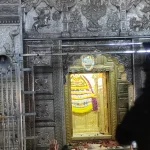
The idol of Shyam is striking—adorned with vibrant turbans, colorful garlands, and intricate silver ornaments. Devotees believe that the expressive eyes of the idol radiate compassion, fulfilling prayers instantly.
The sanctum’s marble walls are complemented by gold-plated borders and delicate inlay work, creating a luminous sacred environment.
3. Stone Carving and Ornamentation
The temple’s interiors and facades exhibit:
- Rajasthani jali work featuring geometric and floral motifs
- Mythological frescoes that narrate episodes from the Mahabharata
- Hand-painted ceilings depicting divine scenes and celestial patterns
- Engraved marble pillars showcasing symmetrical craftsmanship
These details echo the legacy of the artisans of Shekhawati, known for their mastery in decorative architecture.

The Spiritual Experience: Rituals and Daily Worship
Mangala Aarti
The temple day begins before sunrise with Mangala Aarti, where conch shells, bells, and hymns create an immersive spiritual ambience.
Phoolon ki Holi
During special days, the deity is showered with flowers, transforming the temple into a riot of fragrance and color.
Prasad and Offerings
The offering of prasadi—mainly churma, sweets, and coconut—symbolizes purity and devotion.
The Phalguna Mela
Held in February–March, the annual fair draws lakhs of devotees who walk miles to seek blessings. The temple premises and surrounding pathways are illuminated, and cultural performances, devotional music, and community kitchens create an atmosphere of collective celebration.
An Infrastructure Designed for Pilgrimage
Despite its historic nature, the temple complex has been systematically developed to handle the vast crowd that visits throughout the year.
Key infrastructural features include:
- Queue management corridors with steel and marble supports
- Wide entry and exit gates for seamless crowd flow
- Resting areas and shaded spaces for pilgrims
- Drinking water booths and medical centers
- Special darshan lines for senior citizens and the differently-abled
- Parking and township planning integrated with the town’s tourism blueprint
The blend of heritage and functionality reflects how traditional temples can evolve into efficient public spaces without compromising their cultural essence.
Khatu Shyam Ji Mandir in Modern Times
Today, the temple stands not only as a sacred space but also as:
- A cultural landmark inspiring folk art, music, and devotional literature
- A tourism driver for Rajasthan’s Shekhawati region
- A case study in temple management, crowd flow design, and pilgrimage infrastructure
- A symbol of communal harmony, welcoming people from all walks of life
The increasing footfall has also encouraged renovation projects, technological integration into prayer systems, and preservation initiatives aimed at sustaining its heritage for future generations.
Nearby Attractions
Travelers visiting Khatu Shyam Ji often explore other significant sites such as:
- Shyam Kund – the sacred pond where the idol was discovered
- Gourishankar Temple
- Roop Niwas Palace
- Shekhawati fresco towns like Mandawa and Fatehpur
Together, these destinations offer a rich cultural itinerary for architecture enthusiasts and spiritual seekers alike.
A Temple Where Devotion Meets Design
Khatu Shyam Ji Mandir is far more than a pilgrimage center—it is a living heritage site where mythology, devotion, architecture, and community converge. Its marble corridors echo centuries of faith, while its artistic carvings preserve the timeless beauty of Rajasthani craftsmanship.
For devotees, it is the home of Shyam Baba—wish-fulfilling and ever-benevolent.
For architects and cultural historians, it is a remarkable example of how sacred architecture adapts, survives, and continues to inspire across generations.
As India’s spiritual landscape continues to evolve, the Khatu Shyam Ji Mandir remains a shining symbol of tradition, devotion, and architectural grace.

Most Read Articles:
Shri Ram Janmabhoomi Mandir: A timeless confluence of devotion, architecture & cultural heritage
Grand Janki Mandir to Be Built at Punaura Dham Sitamarhi: ₹882.87 Crore Mega Project Announced
Meenakshi Temple: A Living Masterpiece of Indian Architecture
Varanasi International Cricket Stadium: Where Spirituality Meets Sports
Statue of Unity: The World’s Tallest Statue at 182 Metres | A Complete Guide
Maa Vindhyavasini Mandir and Its Corridor: A Divine Fusion of Heritage, Devotion & Modern Vision
Shri Kashi Vishwanath Temple: A Timeless Journey into the Spiritual Heart of India
Tirumala Venkateswara Temple: An Architectural and Spiritual Marvel of South India