
Meenakshi Temple in Madurai
Nestled in the heart of Madurai, Tamil Nadu, the Meenakshi Amman Temple stands as one of India’s most magnificent architectural and cultural landmarks. Revered as a sacred center of worship and a living museum of South Indian art, the temple embodies the zenith of Indian architectural expression — a symphony of stone, sculpture, and spirituality that has captivated architects, historians, and pilgrims for centuries.
A Legacy Rooted in Legend
The origins of the Meenakshi Temple are deeply intertwined with the mythology of Goddess Meenakshi — an incarnation of Parvati — and her consort, Lord Sundareswarar (Shiva). According to legend, Meenakshi was born to the Pandya king Malayadhwaja and was destined to rule Madurai. Her marriage to Shiva, celebrated within the temple’s precincts, symbolizes the cosmic union of male and female energies — a recurring theme in Hindu philosophy and temple iconography.
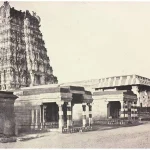
Historically, the temple’s earliest structures date back to the 6th century CE, during the reign of the Pandya dynasty. However, the temple complex as seen today owes much of its splendor to the Nayak rulers of the 16th and 17th centuries, particularly King Tirumalai Nayak. Under his patronage, the temple was rebuilt, expanded, and adorned with grand gopurams (gateway towers) and intricate sculptures, establishing its reputation as a pinnacle of South Indian temple design.

Architectural Brilliance: The Indian Template Perfected
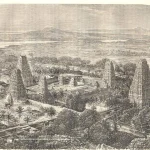
The Meenakshi Temple is a textbook example of Indian architecture — characterized by its towering gateways, intricately carved mandapams (pillared halls), and a meticulous sense of symmetry and hierarchy in spatial organization. Covering an area of about 14 acres, the temple complex is enclosed by massive concentric walls that delineate sacred zones, guiding the devotee’s journey from the mundane to the divine.
The Gopurams: Gateways to the Divine
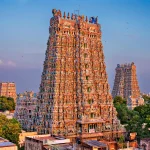
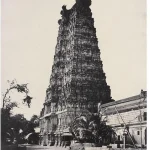
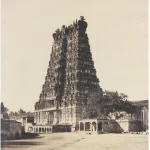
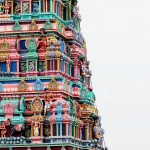
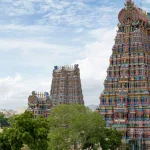
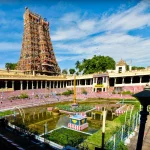
Perhaps the most visually striking aspect of the temple are its 14 gopurams, each soaring between 45 and 50 meters high. The tallest, the southern tower, rises to about 52 meters, dominating Madurai’s skyline. These monumental gateways are adorned with thousands of vividly painted stucco figures — gods, goddesses, demons, and celestial beings — rendered in exuberant poses. The riot of color and detail transforms each gopuram into a vertical narrative of Hindu mythology, blurring the line between sculpture and storytelling.
From an architectural standpoint, these gopurams are not mere entrances but symbolic thresholds. Their tapering pyramidal forms, rhythmic tiers, and ornamental finials embody the ascent toward enlightenment — an allegory mirrored in the devotee’s spiritual journey within.

The Sanctum and Mandapams
At the heart of the complex lie two main sanctums: one dedicated to Goddess Meenakshi and the other to Lord Sundareswarar. Unlike most Hindu temples where the male deity takes precedence, here the goddess holds primacy, reflecting a rare matrilineal significance in temple worship.
Surrounding these shrines are numerous mandapams — vast pillared halls designed for ceremonies, music, dance, and congregation. Among them, the Aayiram Kaal Mandapam or “Hall of a Thousand Pillars” is an architectural marvel. Each pillar, sculpted from granite, bears elaborate carvings of deities, mythical beasts, and celestial nymphs. The symmetry of this hall is so precise that no matter which angle one views it from, the pillars appear perfectly aligned — a testament to the mathematical and aesthetic precision of the builders.
The Vasantha Mandapam (Spring Hall) and Kilikoondu Mandapam (Hall of Parrots) further exemplify the interplay of artistry and function, designed to accommodate seasonal festivals, rituals, and devotional performances that animate the temple throughout the year.

The Temple Tank: A Sacred Oasis
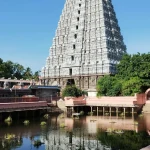
Central to the temple’s spatial and symbolic design is the Potramarai Kulam — the Golden Lotus Tank. Surrounded by colonnaded corridors, this sacred water body serves both ritualistic and ecological functions. In ancient times, devotees would bathe here before entering the sanctum, symbolically purifying themselves. The tank’s reflective surface not only cools the surrounding architecture but also creates a tranquil visual counterpoint to the towering gopurams above — an intentional balance of vertical grandeur and horizontal serenity.
Symbolism, Sustainability, and Spatial Intelligence
Beyond its aesthetic and spiritual dimensions, the Meenakshi Temple showcases sophisticated principles of planning and environmental design. The temple layout follows the Vastu Shastra, the ancient Indian science of spatial harmony. Its axial alignment, proportional geometry, and orientation to cardinal directions ensure optimal light, ventilation, and energy flow.
The stone construction and deep colonnades maintain natural thermal comfort, while open courtyards facilitate air circulation. The temple’s hydrological system — including the central tank and underground channels — exemplifies early sustainable water management. Such features reveal a profound understanding of local climate and materials, underscoring the temple’s timeless relevance to contemporary architectural discourse on sustainability.

A Living Cultural Ecosystem
What truly distinguishes Meenakshi Temple from other historic monuments is that it is not a relic of the past, but a thriving cultural ecosystem. Each day, thousands of devotees, artisans, and priests animate its corridors with rituals, music, and chants. The annual Meenakshi Thirukalyanam festival, celebrating the divine wedding of Meenakshi and Sundareswarar, draws millions of pilgrims and transforms the city into a stage for ritual theater, floral processions, and artistic expression.
For architects and designers, the temple remains an enduring source of inspiration — not only for its formal beauty but for its integration of art, function, and community. It represents architecture as a living organism — one that evolves with its people, yet remains anchored in its philosophical core.

Conclusion
The Meenakshi Amman Temple is more than a marvel of stone and sculpture — it is an embodiment of India’s architectural genius, spiritual depth, and cultural continuity. Its soaring towers and silent corridors invite both devotion and contemplation, reminding us that architecture, at its highest expression, transcends utility to become an experience — a bridge between the earthly and the eternal.
For designers and architects seeking lessons in longevity, symbolism, and craftsmanship, Meenakshi Temple offers a timeless blueprint: build not merely with materials, but with meaning.