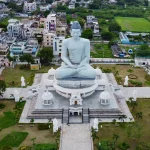

Dhyana Buddha statue in Amaravathi
When Andhra Pradesh was bifurcated in 2014, the state faced an unprecedented urban challenge — to create a new capital city from the ground up. Thus began the ambitious journey of Amaravati, envisioned not merely as a seat of governance but as a world-class, sustainable, and people-centric urban marvel that would represent the aspirations of a new Andhra Pradesh.
Amaravati — named after the ancient Buddhist heritage site located nearby — was imagined as a symbol of progress, balance, and legacy. The city’s name itself, meaning “the city that never dies”, evokes timelessness, cultural continuity, and resilience — qualities that the planners hoped to embed in its design.
The Genesis of a Dream
In June 2014, after the bifurcation of Telangana, Andhra Pradesh lost Hyderabad as its capital. Chief Minister N. Chandrababu Naidu announced a bold plan to create Amaravati on the banks of the Krishna River, between Vijayawada and Guntur. The site was carefully chosen for its strategic central location, fertile agricultural land, and access to water resources.
To make this vision tangible, the government collaborated with Foster + Partners (UK) and Surbana Jurong (Singapore) — two globally acclaimed urban design and infrastructure firms. Together, they developed a master plan for a 217 sq. km city, projected to house over 3.5 million people by 2050.
The design philosophy rested on three pillars — sustainability, innovation, and inclusivity. Amaravati was envisioned as India’s first “People’s Capital”, built with contributions from thousands of farmers who voluntarily pooled their land under a unique Land Pooling Scheme (LPS). This participatory model was globally recognized as a pioneering approach to urban land development.

Urban Design and Architectural Vision
The Amaravati Master Plan laid out a city defined by clean lines, green boulevards, and blue infrastructure. Inspired by global capitals such as Canberra, Brasilia, and Singapore, the plan envisioned a grid-based city layout with clearly demarcated zones for governance, commerce, education, culture, and housing.
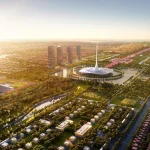
At its heart was the Government Core, designed to house the Legislative Assembly, Secretariat, and High Court, all surrounded by lush gardens, civic plazas, and water bodies. The Legislative Assembly Complex, designed by Foster + Partners, reflected a blend of modern minimalism and traditional Indian symbolism. The building’s circular design represented continuity and inclusiveness, while its open courtyards and shaded corridors reflected the region’s climatic sensitivity.
The plan also emphasized green mobility and climate responsiveness. Nearly 60% of the total area was reserved for green and open spaces, including tree-lined avenues, parks, and riverfront promenades. The Krishna River waterfront was to be transformed into a recreational and cultural hub — a seamless integration of ecology and urban life.
Amaravati was designed as a “Smart City”, equipped with underground utility corridors, smart energy grids, integrated waste management systems, and public transport powered by renewable energy. Its infrastructure blueprint was forward-looking, aligning with India’s sustainability goals and the United Nations’ Sustainable Development Agenda 2030.
The Socio-Economic Framework
Beyond its architecture, Amaravati represented an economic catalyst for the new Andhra Pradesh. The city’s development was expected to attract IT, finance, education, and healthcare industries, creating thousands of jobs and boosting regional growth.
Educational and institutional zones were planned to host international universities, research centers, and innovation hubs — positioning Amaravati as a knowledge capital of South India.
The Land Pooling Scheme was not just an administrative innovation but a social experiment in shared prosperity. Over 28,000 farmers contributed nearly 33,000 acres, receiving developed plots, compensation, and annuity payments in return. This partnership gave Amaravati its unique identity as a city built “by the people, for the people.”
Challenges and Changing Political Winds
However, Amaravati’s journey has been far from smooth. With the change of government in 2019, the project’s direction underwent significant shifts. The new administration proposed the “Three-Capital Model”, distributing the functions of governance across Visakhapatnam (Executive Capital), Kurnool (Judicial Capital), and Amaravati (Legislative Capital).
This decision sparked widespread debates and protests, particularly among Amaravati’s farmers, who had sacrificed their land for the dream of a single, vibrant capital. Work on many infrastructural projects slowed, leaving behind partially built roads, foundations, and unfinished administrative buildings.
Despite the setbacks, Amaravati remains a symbol of aspiration and a case study in urban experimentation. Its rise and struggles underscore the complexities of political continuity, land policy, and sustainable planning in emerging economies.

The Road Ahead
As of 2025, Amaravati’s future continues to evolve. With renewed political and public attention, there are growing calls to revive the original vision of a unified, eco-friendly capital. Several infrastructure projects, including roads, housing, and administrative complexes, are seeing gradual progress.
Urban planners and architects view Amaravati as a living laboratory — a place where ideas of smart infrastructure, citizen participation, and green urbanism can still find meaningful expression.
Whether it ultimately becomes the administrative heart of Andhra Pradesh or transforms into a special economic and knowledge zone, Amaravati has already left an indelible mark on India’s architectural and urban planning discourse. It continues to inspire debates on how new cities can balance vision, viability, and sustainability in a rapidly urbanizing nation.
Conclusion
Amaravati’s story is not just about buildings or master plans — it’s about ambition, identity, and resilience. It embodies the eternal tension between political will and public aspiration, between dream and delivery.
For architects, urban designers, and policymakers, Amaravati stands as both a cautionary tale and a source of inspiration — reminding us that the creation of a capital is not merely an act of design, but an act of faith in the future.