Seva Teerth
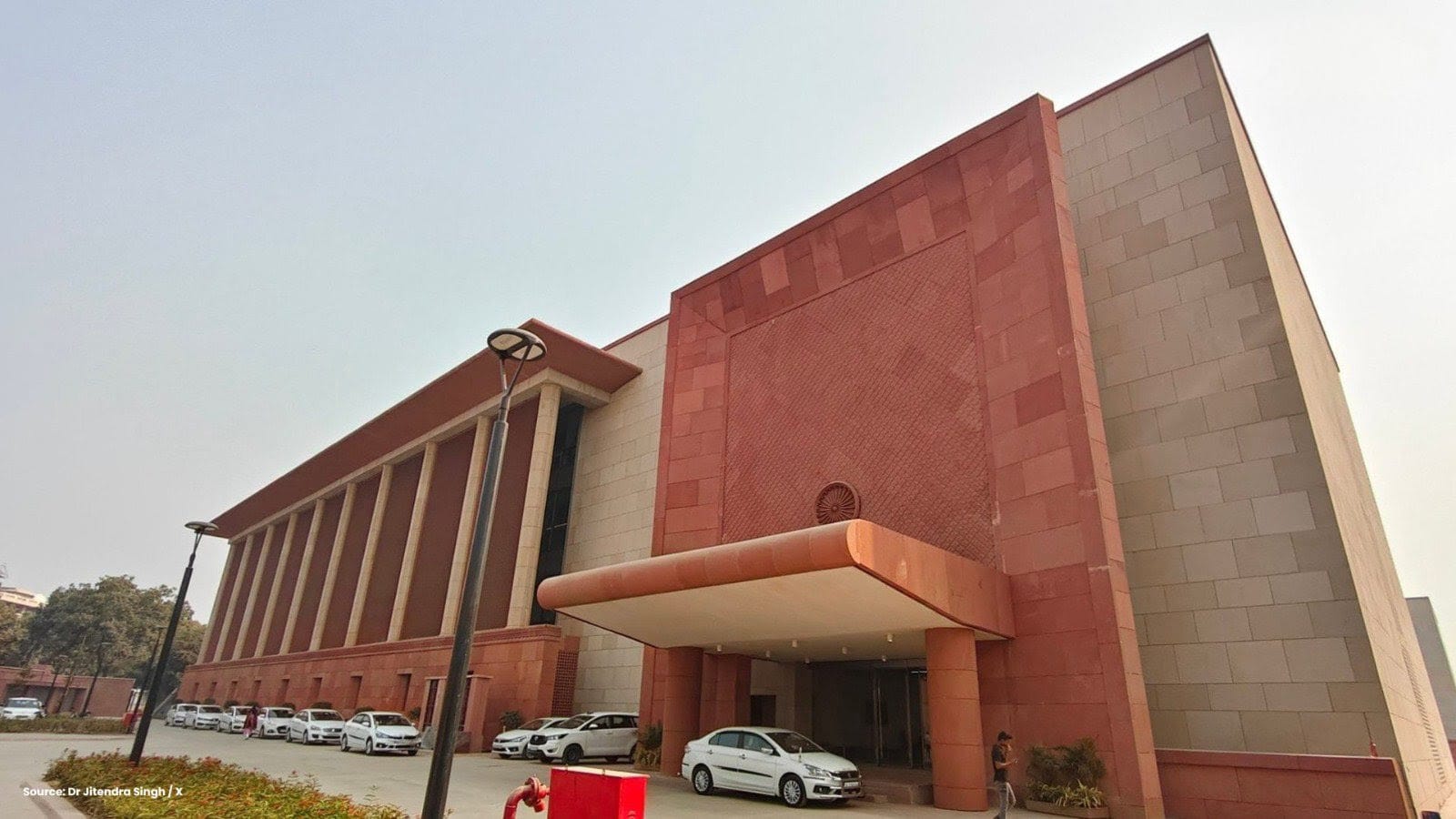
On 13 February 2026, Prime Minister Narendra Modi inaugurated Seva Teerth, the new complex that now houses the Prime Minister’s Office in New Delhi. More than a change of address, the move marks a profound architectural and administrative transition. For decades, the PMO functioned from the colonial-era South Block. With Seva Teerth, the executive nerve center of India shifts into a purpose-built, contemporary environment shaped by efficiency, sustainability, and a consciously articulated philosophy of “service.”
Key Facts:
- Project Name: Seva Teerth
- Architect: HCP Design, Planning and Management Pvt. Ltd. (Dr. Bimal Patel)
- Construction: Larsen & Toubro (L&T)
- Contractor: Tata Projects Limited
- Inauguration Date: 13 February 2026
- Location: Central Vista, New Delhi
- Function: Headquarters of the Prime Minister’s Office (PMO)
- Also Houses: National Security Council Secretariat & Cabinet Secretariat
- Part of: Central Vista Redevelopment Project
- Replaces: PMO operations earlier housed in South Block
- Design Focus: Modern infrastructure, sustainability, administrative efficiency

From Colonial Monumentality to Functional Modernism
The architectural language of South Block was imperial—massive stone façades, grand colonnades, axial symmetry, and spatial hierarchy designed to communicate authority and distance. It was a building conceived in the early 20th century for colonial administration, not for the digital, high-speed governance ecosystem of the 21st century.
Seva Teerth represents a departure from that vocabulary. The new complex is less about spectacle and more about systems. It prioritizes workflow efficiency, digital integration, and interdepartmental proximity. In architectural terms, this signals a move from monumental symbolism to operational functionality.
The scale remains dignified, in keeping with the Central Vista’s urban grammar, but the spatial planning is distinctly contemporary. Instead of rigidly segmented corridors and compartmentalized chambers, the layout encourages coordinated governance through proximity and streamlined circulation.
Architecture as an Instrument of Governance
Seva Teerth was conceived not just as a building, but as infrastructure for decision-making. For architects and planners, this distinction is critical.
Administrative buildings historically conveyed power through verticality and ornamentation. Seva Teerth, in contrast, communicates authority through order, clarity, and technological readiness. The architecture supports:
- Centralized yet flexible office planning
- Advanced digital networks for real-time governance
- Secure but efficient movement systems
- Integrated meeting and strategy zones
This approach reflects a modern understanding: the effectiveness of governance today depends less on grandeur and more on connectivity.

Sustainability and Systems Thinking
One of the defining architectural narratives of the Central Vista redevelopment has been sustainability. Seva Teerth reportedly incorporates renewable energy integration, advanced HVAC systems, water conservation measures, and waste management protocols aligned with green building standards.
For a government complex of this scale, environmental responsiveness is not merely symbolic—it is infrastructural. Orientation, shading strategies, high-performance glazing, and efficient building envelopes are integral to reducing operational load. The shift signals an important architectural lesson: national institutions must embody the environmental standards they promote.
In this sense, Seva Teerth becomes part of a broader national dialogue on responsible construction and long-term resilience.
Urban Context: Central Vista Reframed
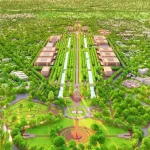
Seva Teerth forms a key component of the larger Central Vista transformation, which aims to reorganize government ministries into cohesive, purpose-built structures. Within this framework, the Prime Minister’s Office becomes both anchor and axis.
The building’s placement strengthens administrative clustering, reducing fragmentation that previously required coordination across multiple locations. Urbanistically, this creates a more coherent governmental district—functionally dense yet spatially ordered.
The architectural strategy respects the ceremonial spine of Kartavya Path while introducing a contemporary design identity. It negotiates continuity and change: maintaining axial discipline while redefining the built language of governance.

Spatial Hierarchy and Accessibility
One of the subtle yet important shifts in Seva Teerth’s design lies in how hierarchy is spatially expressed. Colonial buildings relied on dramatic staircases, elevated plinths, and layered thresholds to create symbolic distance between authority and public.
Contemporary governance architecture, however, leans toward clarity and managed accessibility. While security remains paramount, internal planning emphasizes logical zoning rather than theatrical progression. Reception areas, secure administrative cores, and collaborative spaces are organized with functional precision.
For architects, this reflects a broader evolution: institutional architecture today must balance openness and security without defaulting to fortress aesthetics.
Symbolism Embedded in Naming
The name “Seva Teerth” carries philosophical weight. “Seva” means service, and “Teerth” traditionally refers to a sacred place of pilgrimage. In architectural interpretation, this naming reframes the building as a space where governance is envisioned as public service.
Unlike traditional temples of power, the metaphor here is not transcendence but responsibility. The architecture supports this narrative by focusing on efficiency, coordination, and responsiveness—qualities that align with service-oriented governance.
Whether symbolism translates into lived experience depends on institutional practice. Yet from an architectural standpoint, the renaming aligns the built form with a declared civic ethos.
The Future of South Block
With the PMO’s relocation, South Block and North Block are slated for adaptive reuse as museums. This transition is architecturally significant. It allows heritage structures to be preserved as cultural artifacts while freeing contemporary governance from spatial limitations imposed by early 20th-century design.
The shift acknowledges that historic buildings can be honored without constraining modern administrative function—a pragmatic yet respectful architectural stance.

A Defining Moment in India’s Administrative Architecture
Seva Teerth stands at the intersection of politics, urban planning, and architectural transformation. It represents a conscious attempt to reimagine how state power is housed and expressed.
For architects, the project invites important questions:
- How should democratic governance be spatially articulated in the 21st century?
- Can architecture reinforce administrative efficiency?
- What balance should exist between symbolism and systems performance?
Seva Teerth answers these not through ornament, but through infrastructure.
As India continues to redefine its institutional landscape, this building may well be remembered less for its façade and more for what it enabled—a streamlined, technologically integrated, and symbolically reframed center of executive governance.
In that sense, Seva Teerth is not just a new office complex. It is a case study in how architecture evolves alongside the state it serves.
Related Article:
India’s New Parliament Building: A Modern Symbol of Democracy
Gautam Adani House: Inside the luxurious residence of India’s business tycoon in Ahmedabad
Mukesh Ambani House: Antilia, the world’s most expensive private residence in Mumbai
Jeff Bezos House: Inside the Mansions and Estates of the Amazon Founder
Bill Gates’s House: An inside look at all the homes owned by the Microsoft co-founder
Michael Jordan’s homes: A design-led journey through his signature residences
Abode: Inside Anil Ambani’s iconic Pali hill residence that redefines luxury living in Mumbai
Inside Jalsa: An architectural perspective on Amitabh Bachchan’s iconic Mumbai residence
Abode: Inside Anil Ambani’s iconic Pali hill residence that redefines luxury living in Mumbai
Jatia House: Kumar Mangalam Birla’s iconic home of luxury and heritage in Mumbai
Gulita: The diamond-inspired seafront mansion of Isha Ambani and Anand Piramal
Inside Sea Wind: The 17-Storey family home Mukesh Ambani shared with Anil Ambani before Antilia
Goolestan (Om Arc): Inside Anand Mahindra’s heritage home on Nepean sea road, Mumbai
Deepinder Goyal House: Inside the Zomato Founder’s luxury home at DLF Camellias
Bhavish Aggarwal house: Inside the Ola Co-founder’s Private Residence in Bengaluru
Inside Sundar Pichai and Anjali Pichai’s House: A blend of modern luxury and thoughtful design
Satya Nadella House: A Peek Inside the Microsoft CEO’s Residence