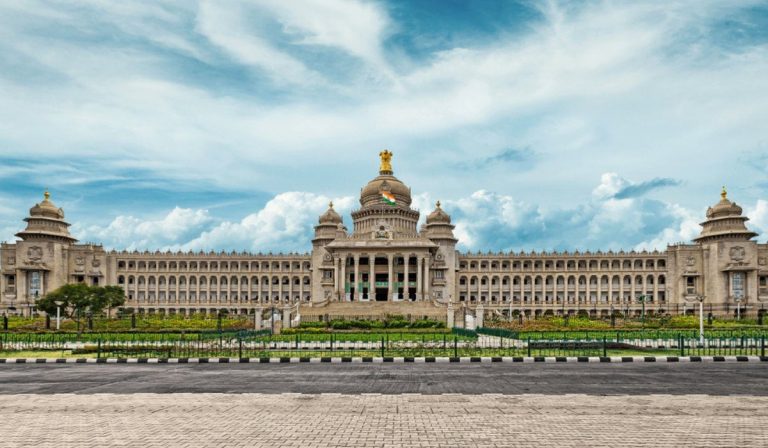
Few government buildings in India command attention the way Vidhan Soudha in Bengaluru does. Rising majestically above the city skyline with its massive granite structure, sweeping staircases, ornate domes, and neo-Dravidian detailing, the building is more than just the seat of Karnataka’s legislature — it is a statement of cultural pride, political identity, and architectural ambition.Constructed in the years following India’s independence, Vidhan Soudha became a powerful symbol of a newly emerging democratic nation determined to express itself through indigenous architecture rather than colonial design language. Even today, nearly seven decades later, it remains one of India’s most iconic legislative buildings.Key Facts:Location: Bengaluru, Karnataka, IndiaFunction: Seat of the Karnataka Legislative Assembly and Legislative CouncilArchitectural Style: Neo-Dravidian architectureConstruction Period: 1952 – 1956Foundation Stone Laid By: Jawaharlal Nehru on 13 July 1951Chief Visionary: Kengal Hanumanthaiah, then Chief Minister of Mysore StateChief Engineer: B.R. ManickamMaterial Used: Primarily graniteHeight: Approximately 150 ft at the central domeBuilding Area: Around 5 lakh sq. ft.Number of Rooms: 172+ roomsFloors: Four floors with one basementFamous Inscription: “Government Work is God’s Work” at the entranceStyle Influences: Chalukyan, Hoysala, Vijayanagara, and Dravidian temple architectureKnown As: “People’s Palace” by Kengal HanumanthaiahVidhan SoudhaThe Vision Behind Vidhan SoudhaAfter India gained independence in 1947, many government institutions still operated from colonial-era buildings. In Bengaluru, administrative functions were carried out from the British-built Attara Kacheri (High Court building).Kengal Hanumanthaiah, the then Chief Minister, envisioned a monumental structure that reflected Indian identity and regional pride rather than colonial influence. His goal was to create a building rooted in Karnataka’s own architectural heritage while symbolizing democratic governance.This vision gave birth to Vidhan Soudha — a structure often described as “poetry in stone.”Former Prime Minister Jawaharlal Nehru reportedly referred to it as a “temple dedicated to the nation.”Architectural Style: Neo-Dravidian GrandeurVidhan Soudha is one of the finest examples of Neo-Dravidian architecture in modern India. The design merges traditional South Indian temple architecture with monumental civic planning.Key Architectural FeaturesMassive granite stairways leading to the main entranceA grand central dome inspired partly by temple vimanasFour corner domes creating symmetry and balanceOrnamental columns and carved friezesIntricately designed teakwood and sandalwood interiorsTemple-inspired motifs including lotuses, elephants, and traditional carvingsLarge courtyards and naturally lit interiorsThe building consciously rejected Gothic and Indo-Saracenic colonial styles that dominated many British-era public buildings. Instead, its inspiration came from the architectural traditions of Karnataka’s historic temple towns such as Belur, Pattadakal, and Aihole.Vidhan SoudhaConstruction and CraftsmanshipThe construction of Vidhan Soudha was a massive undertaking for its time.Thousands of laborers, masons, wood carvers, and sculptors worked on the project over four years. Granite was sourced from nearby regions around Bengaluru including Hessarghatta and Mallasandra. According to historical reports, over 5,000 workers and nearly 1,500 skilled artisans contributed to the project.One of the most fascinating aspects of the structure is the extensive use of locally sourced materials and craftsmanship. The interiors feature polished woodwork, carved doors, decorative ceilings, and detailed stone masonry that showcase Karnataka’s traditional artisan skills.The project was not merely about constructing a government office — it was envisioned as a cultural landmark representing Indian craftsmanship in a post-independence era.Scale and PresenceVidhan Soudha was designed to impress.The building stretches approximately 700 feet in length and 350 feet in width, occupying a prominent site near Cubbon Park in central Bengaluru. Its elevated position and monumental staircases create a dramatic visual impact, especially when viewed from Dr. B.R. Ambedkar Road.At night, the illuminated granite façade transforms the building into one of Bengaluru’s most recognizable landmarks. In recent years, permanent LED lighting installations have further enhanced its nighttime presence.Vidhan SoudhaSymbolism and Cultural IdentityWhat makes Vidhan Soudha architecturally significant is not just its scale, but what it represents.The building emerged during a time when India was actively redefining its national and regional identity. Rather than replicating Western government architecture, Karnataka chose to celebrate local history, temple traditions, and indigenous forms.This approach influenced several later government buildings across India and established Vidhan Soudha as a benchmark for monumental public architecture in the country.Even today, many architects and urban enthusiasts regard it as one of post-independence India’s most aesthetically powerful civic buildings. Public discussions and architectural communities frequently cite it as a rare example where governance infrastructure achieved both symbolic and artistic excellence.Interior Spaces and DesignInside, Vidhan Soudha balances ceremonial grandeur with legislative functionality.The Assembly Hall and Council Chamber feature carefully designed acoustics, large seating arrangements, polished stone finishes, and decorative wood paneling. Public galleries were also integrated into the building, reflecting the democratic principle of transparency and citizen participation.Traditional Indian craftsmanship continues throughout the interiors through carved sandalwood doors, ornamental lighting fixtures, and handcrafted furniture designed locally.Vidhan SoudhaWhy Vidhan Soudha Still Matters TodayIn an era dominated by glass façades and minimalist office towers, Vidhan Soudha stands apart as a reminder that public architecture can carry emotion, identity, and cultural memory.The building continues to function as Karnataka’s political center while also serving as one of Bengaluru’s most celebrated landmarks. Tourists, photographers, architecture students, and historians are drawn to it not only for its political significance but for its remarkable design language.More importantly, Vidhan Soudha proves that architecture can become a symbol of collective aspiration — a structure that reflects both governance and cultural confidence.Vidhan Soudha is not just a legislative building; it is an architectural narrative carved in granite. From its neo-Dravidian vocabulary and handcrafted detailing to its symbolic role in post-independence India, the structure represents a rare fusion of politics, craftsmanship, and cultural identity.Nearly seventy years after its completion, it continues to dominate Bengaluru’s architectural landscape — timeless, monumental, and deeply rooted in Indian heritage. Vidhan Soudha Vidhan Soudha Vidhan Soudha Vidhan Soudha Vidhan Soudha Vidhan Soudha Vidhan Soudha Related Article:Puja Casa, Bandra: Inside a contemporary luxury residence in Mumbai’s prestigious Pali HillOmkar 1973 Worli: Inside Mumbai’s iconic luxury skyscraper by Foster + PartnersRustomjee Crown: A new benchmark for luxury living in South MumbaiRaheja Artesia, Worli: Inside Mumbai’s most exclusive ultra-luxury residential towerBeauMonde Towers, Prabhadevi: Inside Mumbai’s most coveted luxury address – Architecture, amenities, celebrities & key factsDLF Camellias: Inside India’s most luxurious residential address