
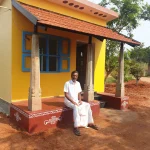
Sridhar Vembu’s House (Source Sridhar Vembu X account)
Sridhar Vembu’s House: Architecture, Context & Philosophy — A Rural Revival in Built Form
Sridhar Vembu — the Indian entrepreneur, Padma Shri awardee, and founder of Zoho Corporation — is not just known for building one of the world’s most quietly powerful tech companies; he’s equally renowned for the unconventional way he lives and works. Unlike tech icons who choose skyscrapers and gated estates, Vembu chose a simple rural home in Tamil Nadu that embodies his deep philosophy: architecture as cultural continuity, practicality, and sustainability.
From Silicon Valley to a Tamil Village: The Backdrop of His Home
Born in 1968 in a village in Thanjavur district, Tamil Nadu, Vembu’s rural roots shaped his worldview early on. After earning an engineering degree from IIT Madras and a PhD from Princeton University, he worked in the United States for companies like Qualcomm. But in October 2019, he made a striking decision — leaving the Silicon Valley way of life to move to Mathalamparai, near Tenkasi in Tamil Nadu — where Zoho had already established a campus.
His residence is not a luxury villa; it’s a home deeply integrated with the land, local climate, and community. Vembu chose to live in Govindaperi (a village near Tenkasi), among farmland, paddy fields, and the Western Ghats, reflecting his belief that talent exists everywhere — not just in metros.
The Architectural Identity of Vembu’s Home
1. Simplicity Rooted in Tradition
While Vembu has not publicly disclosed floor plans or official architectural renders of his personal house, multiple reports and interviews suggest that his home follows vernacular rural architecture — incorporating local materials and climatic logic. This includes:
- Mud brick or brick walls which provide excellent thermal mass and natural insulation — keeping interiors cool even in hot weather without air conditioning.
- A thatched or tile roof, common in traditional Tamil homes, which reduces heat gain relative to concrete slabs.
- Open courtyards and shaded verandahs — architectural elements that promote cross-ventilation, social space, and a seamless indoor-outdoor relationship.
These design choices are not accidental; they reflect a belief that architecture should respond to local climates and contexts, a point Vembu has reiterated while speaking to architects and designers about sustainable design principles.

2. Sustainability by Design
Vembu’s residence exists in conversation with its environment. In an era dominated by glass towers and climate-controlled interiors, his decision to embrace design that works with nature, not against it is a powerful statement in architectural sustainability:
- Mud brick thermal benefits: Mud brick walls moderate temperature swings and reduce cooling loads.
- Ventilation and daylighting: Openings and courtyards allow natural air movement and daylight, minimizing artificial lighting and mechanical systems.
- Reuse of local materials: The use of stone and palm leaf thatch typifies low-embodied energy construction.
His lifestyle exemplifies passive architectural strategies — a growing focus in sustainable design circles globally.
A House That Is More Than Just a Home
Vembu’s home isn’t merely a shelter; it’s part of a larger rural ecosystem that includes farms, community learning centres (Kalaivani Kalvi Maiyam), and Zoho rural offices. On his farm in Govindaperi:
- There are agricultural fields and livestock, making the home part of a productive landscape.
- The learning centre for rural children sits near his residence, showing his commitment to community-oriented spatial planning.
- The home-office relationship blurs — Vembu once shared images of working in spaces made with mud, straw, and limestone that felt like extensions of the home ethos.
This integration of work, residence, education, and farming is reminiscent of traditional Indian ashram models, where living, learning, and working coexist spatially and socially.

Cultural and Architectural Significance
From an architectural standpoint, Vembu’s lifestyle and home environment challenge contemporary notions of luxury and success. Instead of promoting glass-faced urban residences, his living space:
- Encourages climate-responsive design over high-energy mechanical solutions.
- Embraces local craftsmanship and materials rather than imported finishes.
- Reaffirms the value of vernacular architecture — not as nostalgic revivalism, but as pragmatic, resilient, and contextually relevant design.
In speeches to architecture students and sustainability forums, Vembu highlights how traditional regional homes, like the ancestral mud-brick house in his family that stood for over two centuries, outperform many modern buildings in general comfort and energy efficiency. He uses this as a lesson for future designers to ground their work in context, climate, and culture.

A Modernist Message Through Traditional Form
What makes Sridhar Vembu’s house notable — and worthy of an architectural blog — isn’t just its materiality or design features but the philosophy it embodies:
- Architecture as human-centric: Focused on comfort, simplicity, and harmony rather than spectacle.
- Sustainable living by default: Built with materials and strategies that reduce environmental impact.
- Integration with community and work: Challenging the separation of home, office, and society.
In an era of homogenized design trends, Vembu’s home prompts us to ask: Can future architecture be both globally relevant and deeply local? His life suggests it can.
A Home that Tells a Story
Sridhar Vembu’s house is not just a physical structure; it’s an architectural manifesto. One that speaks to sustainability, cultural rootedness, and the potential for technology leaders to live in ways that honor place and people. For architects, designers, and urbanists, this residence — and the philosophy underpinning it — is more than a curiosity; it’s a case study in how architecture can embody values, not just aesthetics.
From mud walls and thatched roofs to community-centered planning, his home exemplifies how local wisdom and modern purpose can cohere into a powerful built environment narrative.




Related Article:
Elon Musk’s Houses: Tour the Stunning Homes Owned by the Tesla Billionaire
Mark Zuckerberg’s Houses: An Inside Look at the Luxurious Homes of Facebook’s Founder
Gautam Adani House: Inside the luxurious residence of India’s business tycoon in Ahmedabad
Mukesh Ambani House: Antilia, the world’s most expensive private residence in Mumbai
Jeff Bezos House: Inside the Mansions and Estates of the Amazon Founder
Bill Gates’s House: An inside look at all the homes owned by the Microsoft co-founder
Michael Jordan’s homes: A design-led journey through his signature residences
Abode: Inside Anil Ambani’s iconic Pali hill residence that redefines luxury living in Mumbai
Inside Jalsa: An architectural perspective on Amitabh Bachchan’s iconic Mumbai residence
Abode: Inside Anil Ambani’s iconic Pali hill residence that redefines luxury living in Mumbai
Jatia House: Kumar Mangalam Birla’s iconic home of luxury and heritage in Mumbai
Gulita: The diamond-inspired seafront mansion of Isha Ambani and Anand Piramal
Inside Sea Wind: The 17-Storey family home Mukesh Ambani shared with Anil Ambani before Antilia