The Art of Capturing Spaces: A Conversation with Architecture Photographer Sagar Bhavsar
Architecture and interior photography is no longer just about documenting finished spaces. Today, it has evolved into a powerful storytelling medium that helps architects, designers, and brands showcase not only the final outcome but also the creative process behind every project.
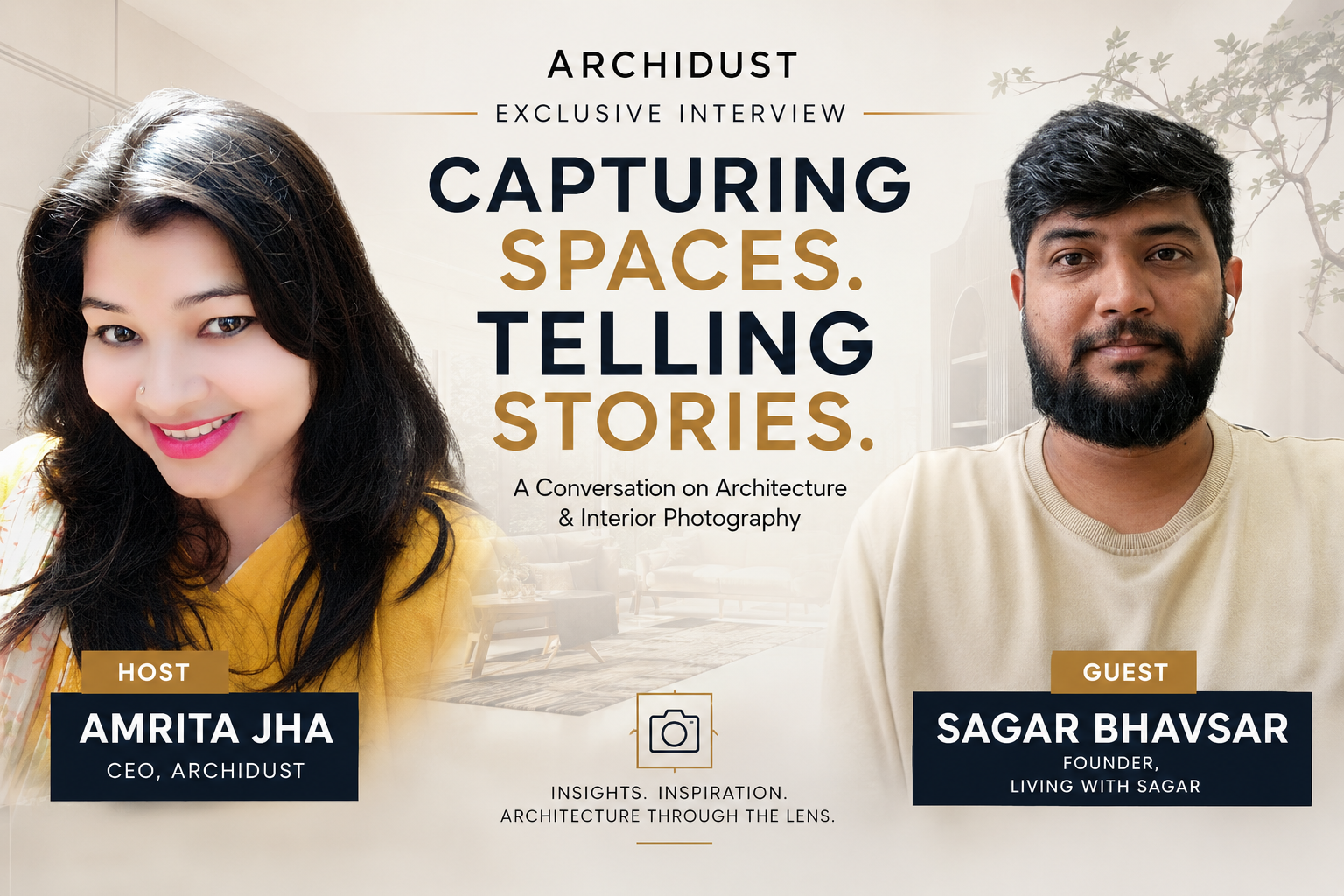
In an exclusive conversation with Amrita Jha, CEO of Archidust, architecture photographer Sagar Bhavsar shared his journey, experiences, challenges, and thoughts on the rapidly evolving world of interior and architectural photography.
Amrita Jha: Welcome to another inspiring conversation with Archidust. I am Amrita Jha, your host, and today we explore the passion, creativity, and storytelling behind the lens that brings stunning spaces to life.
Joining us today is Sagar Bhavsar, founder of Living With Sagar, who specializes in architecture and interior photography. Welcome, Sagar.
Sagar Bhavsar: Thank you for the wonderful introduction. I am Sagar Bhavsar, founder of Living With Sagar. We specialize in architecture and interior photography. I have been in this field for around 9–10 years now, and independently for almost three years.
I actually started as an assistant to my mentor, Tejas Sir, and gradually began handling individual projects.
Amrita Jha: Did you always want to become a photographer?
Sagar Bhavsar: Not really. It wasn’t a childhood dream. During my second year of college, I started exploring photography professionally. Most of my close friends were architects and interior designers, so I began photographing their projects as practice. That’s how I slowly entered architecture photography.
Interestingly, I am actually a mechanical engineer by education. But I knew very early that I wasn’t made for a regular job. I always wanted to build my own business, and photography became that path for me.
Amrita Jha: What makes architecture photography different from wedding or event photography?
Sagar Bhavsar: There is a huge difference. A great wedding photographer may not necessarily be good at architecture photography because both require a completely different mindset.
In wedding photography, photographers capture moments and emotions. Subjects are constantly moving, and timing is everything.
But in architecture and interior photography, the subjects are static. Our work is about framing, composition, lighting, and creating balance within a space. We have time to carefully compose every frame.
Amrita Jha: When are photographers usually called for a project — during construction or after completion?
Sagar Bhavsar: Earlier, photographers were usually hired only after project completion. The focus was on final polished images for publications.
But today the trend has changed completely. Every architect and interior designer is now also a content creator. Clients want to showcase the entire process — from construction stages to the final reveal.
Now photographers are involved throughout the project journey. Designers want behind-the-scenes content, process videos, before-and-after transformations, and storytelling around materials and finishes.
Personally, I feel the current trend is much better because people now understand the effort and process behind creating a space.
Amrita Jha: How has photography evolved over the years?
Sagar Bhavsar: Photography has evolved a lot. Earlier, heavily edited images were preferred. Photographers used to remove air conditioners, switchboards, and practical elements from interiors to make spaces look cleaner.
Today, realism matters more. If a switchboard or AC is part of the design, it should remain visible because the designer intentionally placed it there.
Now the focus is less on over-editing and more on showing authentic spaces.
Amrita Jha: What role does lighting play in architecture photography?
Sagar Bhavsar: Lighting has a massive impact. In architecture photography, there are mainly two styles.
One is ambient photography, where we use only natural light.
The second is flambient photography, where we mix flash lighting with ambient light.
Personally, I prefer natural daylight because most interiors are designed keeping daylight in mind. But in hospitality projects like hotels and restaurants, flash lighting helps highlight certain details and create depth.
Amrita Jha: Have you faced any major challenges during shoots?
Sagar Bhavsar: Definitely. For us, the challenge is always about how to capture a particular shot.
There was one project where the elevation looked beautiful, but we didn’t have enough space to capture it properly. We needed height to get the perfect angle, so we rented lifting equipment normally used by electricians.
We spent almost five to six hours setting up just one shot because we wanted to capture it perfectly without using a drone.
Amrita Jha: Have you ever tried other forms of photography like weddings or newborn shoots?
Sagar Bhavsar: (Laughs) Yes, I once tried newborn photography, but I realized I am very bad at human photography.
Architecture photography is already one of the toughest forms of photography, and newborn photography felt even harder for me. After that experience, I decided to stay focused on interiors and architecture.
Amrita Jha: What advice would you give to young photographers?
Sagar Bhavsar: Practice is everything. Watching YouTube tutorials alone will not make you a photographer.
Take your camera, go outside, experiment with framing, lighting, tripod heights, and compositions. Even your own room can become a practice space.
Practical experience teaches much more than theory.
Amrita Jha: Where do you see architecture photography going in the next few years?
Sagar Bhavsar: Honestly, trends are changing so fast that even predicting the next five years feels impossible.
A few years ago, reels didn’t even exist in our industry. Today, we shoot mobile reels regularly for social media.
Photography styles, content formats, and audience preferences are evolving constantly. Adaptability is now one of the most important skills for photographers.
Amrita Jha: Thank you so much, Sagar, for sharing your journey, experiences, and insights with us. Wishing you all the very best for the future.
Sagar Bhavsar: Thank you so much. It was wonderful speaking with you.