
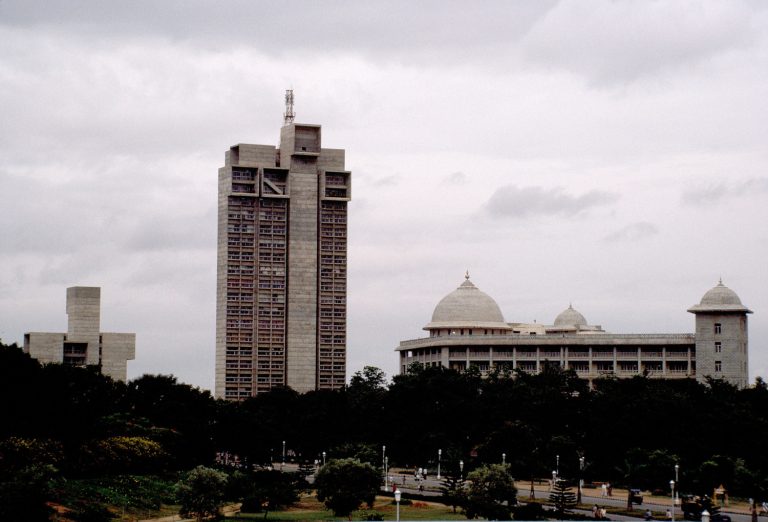
Visvesvaraya Tower is a significant government office building located in Bengaluru. It forms part of the larger administrative precinct and is closely associated with the legacy of Sir M. Visvesvaraya, one of India’s most respected engineers and planners. The tower stands as a functional institutional structure while also being recognized for its architectural value within the context of modern Indian architecture.Architectural Authorship and Design IntentThe building is attributed to the late Indian architect Charles Correa, whose work played a defining role in shaping post-independence architectural identity in India. His approach often balanced modernist principles with contextual and climatic responsiveness, and Visvesvaraya Tower reflects this design philosophy through its restrained form and strong functional clarity.Key Facts:Architect: Charles CorreaLocation: Bangalore, Karnataka, IndiaCompleted: 1983Owner: Government of KarnatakaArchitectural style: BrutalistHeight: 85 m (279 ft)Floor count: 21Material: ConcreteVisvesvaraya TowerBrutalist Character of the BuildingVisvesvaraya Tower is widely regarded as one of the few notable examples of Brutalist architecture in India. The design is defined by its use of exposed concrete, bold geometric massing, and a clear expression of structural form. Rather than relying on decorative elements, the building communicates through scale, proportion, and material honesty.The heavy, block-like composition of the tower gives it a monumental presence within the administrative landscape. This architectural language aligns with Brutalism’s global principles, where raw materiality and functional expression take precedence over ornamentation.Functional Planning and Institutional RoleThe building functions primarily as an administrative office tower within the government complex. Its planning is guided by efficiency, circulation clarity, and institutional utility. Large floor plates and repetitive structural grids support its role as a working government facility rather than a symbolic or commercial landmark.The design reflects a period in Indian architecture when public buildings were expected to embody discipline, permanence, and operational efficiency, particularly in rapidly developing urban centers like Bengaluru.Visvesvaraya TowerClimatic and Contextual ResponseAlthough strongly Brutalist in appearance, the building also incorporates practical responses to Bengaluru’s climate. Deep structural recesses, shaded façades, and the thermal mass of concrete help regulate internal temperatures. These passive strategies are consistent with Correa’s broader architectural approach, which often integrated environmental considerations into modernist frameworks.Cultural and Architectural SignificanceVisvesvaraya Tower carries symbolic importance beyond its physical structure. Named after Sir M. Visvesvaraya, it represents India’s engineering legacy and the spirit of nation-building through infrastructure and planning. The building also reflects Bengaluru’s evolution into a major administrative and institutional hub.In architectural discourse, the tower is significant as a rare surviving example of Brutalist government architecture in India. It offers insight into how post-independence India adopted global architectural movements while adapting them to local needs and governance systems.Visvesvaraya TowerContemporary RelevanceToday, Visvesvaraya Tower remains relevant as both a functioning office building and a subject of architectural study. It contributes to ongoing discussions about the preservation of modernist and post-independence heritage structures in India. As cities rapidly transform, buildings like this serve as important references for understanding the evolution of institutional architecture and design thinking in the country. Visvesvaraya Tower Visvesvaraya Tower Visvesvaraya Tower Visvesvaraya Tower Visvesvaraya Tower Related Article:Puja Casa, Bandra: Inside a contemporary luxury residence in Mumbai’s prestigious Pali HillOmkar 1973 Worli: Inside Mumbai’s iconic luxury skyscraper by Foster + PartnersRustomjee Crown: A new benchmark for luxury living in South MumbaiRaheja Artesia, Worli: Inside Mumbai’s most exclusive ultra-luxury residential towerBeauMonde Towers, Prabhadevi: Inside Mumbai’s most coveted luxury address – Architecture, amenities, celebrities & key factsDLF Camellias: Inside India’s most luxurious residential addressAD Classic: Exploring the Vision Behind Kanchanjunga Apartments by Charles Correa