Inside the mind of an architect
The Arc of Design: A Conversation on Creativity, Challenges, and the Future of Architecture
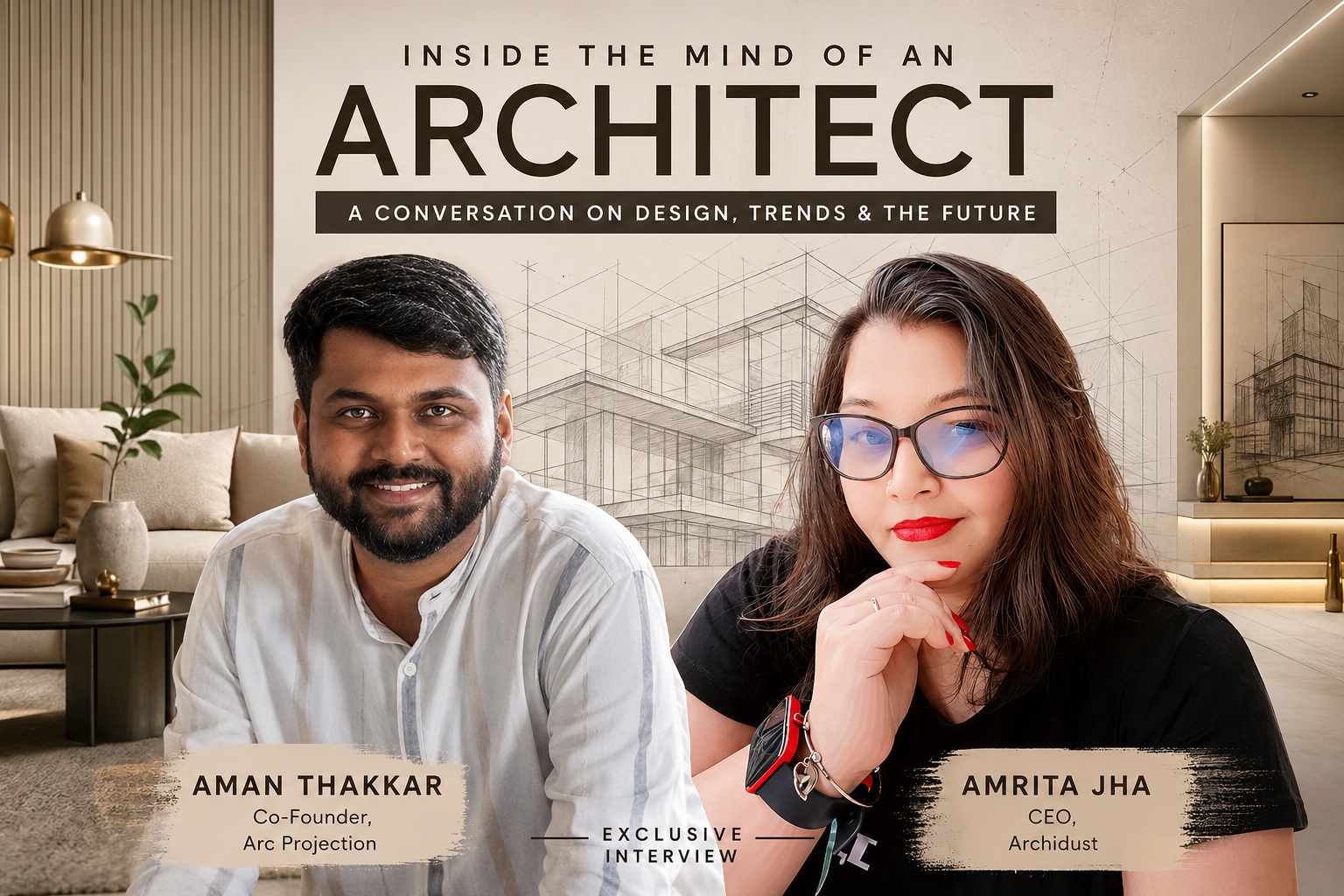
In this exclusive conversation, Amrita Jha (CEO, Archidust) sits down with Aman Thakkar (Co-Founder, Arc Projection) to explore ideas, design thinking, and the future of creativity in architecture.
Amrita Jha: Hello and welcome. My name is Amrita Jha, and I am delighted to have you here with us. Today, we are joined by the renowned architect from Gujarat, Mr. Aman Thakkar. First and foremost, welcome to the show. Sir, could you please introduce yourself?
Aman Thakkar: My name is Architect Aman Thakkar, Co-Founder of Arc Projection. Our firm is based in Vadodara. We have been registered as a firm since 2020, working on interior architecture and hospitality projects all over Gujarat—and across India as well. We have many projects ongoing in the interiors space.
Amrita Jha: What is your educational background in the field?
Aman Thakkar: I first completed a diploma in Architecture Assistantship at M.S. University. After that, we had four months of training, which I completed in Boria itself. Then, I started my Bachelor’s degree near S.I.K., where I completed my graduation. That is my educational journey regarding architecture.
Amrita Jha: What was your main motivation to enter this design field? Was there a family background in design, or was it a childhood dream?
Aman Thakkar: Honestly, there were no architects in my family background, but there were some connections with people doing design-related work and interiors. Even back then, the idea was: let’s do something in design so that our future scope is good. I had a little bit of an interest in design since childhood—sketches, designing, etc. So, I carried that forward. Before 12th grade, I did a diploma to properly understand what architecture really is. After that, I developed further and pursued my Bachelor’s in Architecture. I can’t exactly call it a childhood dream, but it was there from a certain standard onwards.
Amrita Jha: Tell us about your very first project after completing your internship.
Aman Thakkar: After my diploma, I did an internship. Then, during the third year of my Bachelor’s, a friend of mine came to me and said, “I want to design a bungalow.” That was a turning point to start freelancing. The project was a bungalow of around 2,500 square feet. We took their requirements and started designing a duplex. That was in 2018. After completing that bungalow, we have never had a gap in projects—continuously, from start until today, we have been working. That project was special because the client was my classmate, and that work has continued ever since.
Amrita Jha: Please tell us in detail about your company, Arc Projection.
Aman Thakkar: We started Arc Projection in March 2020. After freelancing for a while, we realized we needed a name. My co-founder, Chunal Patel, and I sat down to brainstorm names. That’s how “Arc Projection” came to life. The name comes from the idea that everything in our surroundings is within a radius arc—nothing is completely flat or a straight line. The starting point is an arc, and all things exist around it, within its projection. That’s how the name Arc Projection was born.
Amrita Jha: You started in 2020, when COVID was at its peak. Did COVID affect architecture?
Aman Thakkar: Yes, very much. We started our office on March 18, 2020, and the lockdown began on March 23. That was a huge headache because projects had just started, and many clients backed out, saying they no longer wanted to proceed. But after COVID subsided, two or three projects were revived, which gave us a good spark for the future. During that time, we also got a great opportunity to learn new software and update ourselves. So, while there were no projects from the client’s side, we could enhance our background studies. It was a plus-minus situation.
Amrita Jha: Do you also take on renovation projects? If a client wants to renovate a 25-year-old house and reuse their old furniture, how do you approach that?
Aman Thakkar: Yes, we have done many renovation projects. During COVID itself, our first post-lockdown project was the renovation of a 25-year-old house where the clients wanted to reuse their furniture. We tried our best to achieve that. Renovation is common in many of our projects, especially where budget constraints exist. We always keep that in mind while designing.
Amrita Jha: If you had to choose between a fresh project on open land and a renovation project, which do you prefer, and which is more challenging?
Aman Thakkar: Renovation definitely has more challenges. On open land, challenges exist, but solutions can be planned well in advance. In renovation, there are many boundaries and restrictions—you cannot damage certain things. Your creativity gets a bit caged. Sometimes renovation offers great opportunities, but if I had to choose between land and renovation, I would choose land first.
Amrita Jha: What is the difference between using wallpaper in a home versus an office?
Aman Thakkar: The difference lies in where you are using it. If there is a moisture or water seepage problem, wallpaper will become useless within three or four months. Functionality matters more. In residences, wallpaper works very well in rooms.
Amrita Jha: What about PVC panels? How do they differ from wallpaper?
Aman Thakkar: Cost-wise and aesthetic-wise, it depends entirely on the mood board you have designed. PVC panels are often used where there is a seepage problem and wallpaper isn’t an option. Budget-wise, wallpaper is cheaper. You can get good aesthetics within a limited budget.
Amrita Jha: Which is better for a bedroom: wallpaper or simple painting?
Aman Thakkar: With paints, you can create murals and many things. But many people want a paneled look without the budget for actual panels. They want something more than just paint. Wallpaper now comes in so many varieties that we can simply paste it and give them the desired aesthetics. For aesthetics, wallpaper is often better than paint because it creates a 3D-like effect.
Amrita Jha: Many clients want a temple (puja room) in their residence. Would you suggest an in-built temple against a wall or a ready-made one?
Aman Thakkar: We prefer to customize and design on-site. We do not prefer readymade temples because the opportunity to design becomes very restricted. It’s much better to customize a design and provide a dedicated space for the temple. That gives us more design options.
Amrita Jha: When creating a bathroom on open land, is an attached bathroom the best option?
Aman Thakkar: Yes, attached bathrooms are best because you can manage space well. You don’t have to divide spaces unnecessarily or increase costs. Attached bathrooms add functionality. Nowadays, we also use glass partitions to divide dry and wet areas.
Amrita Jha: What about kitchens? In India, space is often limited. Is open kitchen or closed kitchen better?
Aman Thakkar: For India, a closed kitchen is the best option. We have many different traditions. If a guest arrives, we generally don’t prefer to cook in front of them. Our culture involves tasting the food before serving it—you cannot do that in an open kitchen. Functionality-wise, closed kitchens are best. However, due to land costs, open kitchens are becoming common, but clients often add partitions to hide the kitchen when needed.
Amrita Jha: With social media platforms like Pinterest, clients often come to you with fixed ideas. How do you manage clients who think they already know design?
Aman Thakkar: Clients don’t usually spend much time on research—maybe half an hour. They get their first feed of images, and five or six out of ten clients will share very similar reference images because they haven’t explored deeply. We recognize that pattern. We then convince them saying, “This is trending, but we think this new direction could be the future for your design.” Many clients simply trust us and finalize our mood boards without doing their own research.
Amrita Jha: Lighting has changed a lot—from old-style chandeliers to modern brackets. What is best according to you?
Aman Thakkar: It all depends on how you design your house and what theme your interior designer or architect has created—modern or traditional. Trust your interior designer and architect. They know the best combination. No light is inherently bad for a theme; it’s about how it pairs with the theme. Lighting is required in every space—living room, bedroom. With work-from-home culture, people spend more time in bedrooms, so task lighting and ambient lighting are designed according to the square footage of the space, not just the room type.
Amrita Jha: Mirrors have evolved too—now they come with lighting. Which is better: traditional mirrors or new lighted ones?
Aman Thakkar: Everyone has a different habit and getting-ready routine. People want privacy while getting ready. Mirrors need proper lighting to be functional. If you place light behind a person standing in front of the mirror, it casts a shadow and they won’t see their face clearly. Front lighting with good intensity is far better.
Amrita Jha: Who provides the materials for your projects? Do you have fixed vendors?
Aman Thakkar: We have our own panel of vendors. We complete the entire turnkey project with our own materials and team, based on a defined budget for the space. We do have tie-ups, but every project may go to a different vendor depending on the design theme. We don’t have fixed vendors for every project. For consultancy-based projects, we give good references, and clients buy their own materials. Our main focus is that our aesthetics and thought process are achieved.
Amrita Jha: What changes do you see in the next five years in architecture?
Aman Thakkar: Aesthetic changes will come fast. Many changes will happen, but the base ground will remain the same—sustainable buildings, green buildings will stay as they are. But variations in aesthetics and new materials will emerge. As materials become more expensive, alternative options will also come up.
Amrita Jha: What is your opinion on terrace gardens versus ground landscaping?
Aman Thakkar: Ground options are always better because nature is best at that level. Terrace gardens are an alternative for landscaping, but first preference is always land. Roots grow better in the ground.
Amrita Jha: Does water seepage become an issue with terrace gardens?
Aman Thakkar: If proper treatments are done, seepage will not happen. Damp-proofing is applied over the RCC, then black soil is added. A proper water outlet must be provided for excess water. With proper planning and a good agency for execution, seepage is not an issue. If planning is good but on-site execution is poor, problems can arise. Both the client’s vision and the agency’s tuning matter.
Amrita Jha: What about fiber swimming pools on terraces for spaces that lack ground area? Good or bad?
Aman Thakkar: Economically, if you want a pool, the traditional method will cost more upfront but has long-term benefits. Fiber pools have higher maintenance costs. However, for rented spaces like restaurants or resorts where you might shift after a few years, fiber is a one-stop solution that you can remove and reuse. But traditionally built pools are better for long-term aesthetics and benefits.
Amrita Jha: What has been your most memorable project so far?
Aman Thakkar: Every project, when completed, adds to my memory. In each project, there is something that was very good—a balcony cantilever, a unit design, certain elements. New projects keep adding new memories. It’s not that one project has everything and another has nothing. Many elements become family stories.
Amrita Jha: Finally, what is your mantra for young people who want to enter this line of work?
Aman Thakkar: My only mantra is: be patient. Nowadays, I see youngsters get one or two projects and immediately think they can start their own firm. But you need patience—to start your firm and to run it. Work a job for one or two years, then develop your own firm. There are many challenges. Projects will keep coming, and the future will be good, but patience is the key. This field is entirely about patience.
Amrita Jha: Thank you so much, sir, for joining us. I wish you all the best for your future planning.
Aman Thakkar: Thank you so much for inviting us to this interview.