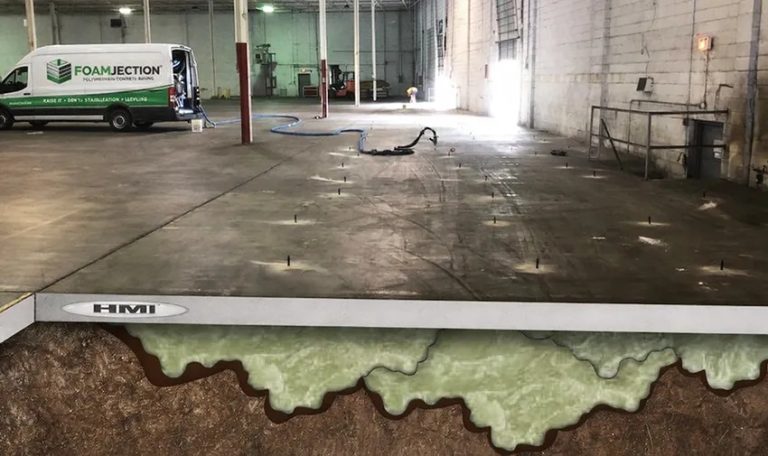
In warehouses, factories and distribution centers, the floor slab is part of the operation. It carries racking, forklifts, pallet jacks and heavy machinery every day. When sections of that slab settle, the effects ripple outward: racking goes out of plumb, forklifts jolt over uneven joints, and small trip edges turn into real safety and maintenance problems.For years the standard answer was to cut out the damaged area and pour new concrete. Today many facility managers and engineers look first at slab lifting, and in particular at polyurethane foam leveling, which can restore a floor with far less downtime.Why industrial slabs settleMost slab settlement comes down to what is happening below the concrete rather than the concrete itself:Poor initial compaction. If the subgrade was not compacted properly during construction, it continues to consolidate under load for years.Washout and erosion. Leaking pipes, failed floor drains or groundwater movement can carry soil away and leave voids under the slab.Heavy, concentrated loads. Racking legs, storage tanks and machinery bases place high point loads on the subgrade, which can compress over time.Expansive or soft soils. Clay soils shrink and swell with moisture changes, and soft soils simply give way under sustained weight.Joint deterioration. Once joints lose load transfer, slabs begin to move independently and edges start to curl or drop.The cost of an uneven floorSettlement is rarely just a cosmetic problem. Uneven slabs can cause:Forklift wear and damaged loads when wheels hit dropped jointsRacking that leans or loses its rated capacityTrip hazards and claims in areas with foot trafficPooling water and accelerated joint damageProblems for automated or guided equipment that depends on a flat surfaceRepair options comparedRemove and replace. Cutting out and repouring sections addresses the slab but not always the soil beneath it. It also means demolition, curing time and, often, days of lost use for that part of the facility.Grinding. Grinding can smooth small lips at joints but does nothing about voids or ongoing settlement.Mudjacking. A cement-based grout is pumped under the slab to fill voids and lift it. It is effective but heavy, typically well over 100 pounds per cubic foot, which adds load to soils that may already be struggling. It also requires larger injection holes and time to cure.Polyurethane foam leveling. A two-part polyurethane is injected through small holes, roughly five-eighths of an inch, drilled through the slab. The material expands, fills voids and lifts the concrete back toward level in controlled stages. Most structural lifting foams weigh only a few pounds per cubic foot, so they add very little load to the subgrade, and they do not absorb water or wash out.Why polyurethane suits industrial facilitiesFor many operations, the biggest advantage is time. Foam reaches most of its strength within minutes, so areas can often go back into service the same day. Work can be planned in zones around shifts or over a weekend instead of shutting down an aisle for a week.Other benefits include:Precision. Lifts are made gradually while the crew monitors with lasers or dial indicators.Clean work. Small holes and a contained process mean less dust and disruption around inventory.Void filling. The same process fills voids under slabs that have not yet dropped, helping prevent future settlement.Longevity. Because the material is stable and water resistant, a properly done lift tends to hold for many years.When foam is not the right answerSlab lifting works when the concrete itself is in reasonable condition. A slab that is badly shattered, or a floor that needs to be redesigned for new loads, may still call for replacement. A soil investigation can also be worthwhile where settlement is severe or ongoing, since deeper soil stabilization may be needed alongside the lift.Planning a floor leveling projectBefore calling in a contractor, it helps to:Map the problem areas and measure joint differentialsNote where racking, equipment and traffic lanes sitLook for causes such as leaking drains or pipes, and fix those firstDecide which zones can be taken out of service and whenExperienced providers of warehouse floor leveling can usually assess a facility, recommend whether lifting or replacement makes sense, and stage the work to keep operations moving.A sunken industrial floor rarely gets better on its own. Addressing settlement early protects equipment, keeps people safe and avoids the far larger cost and disruption of a full slab replacement down the road.