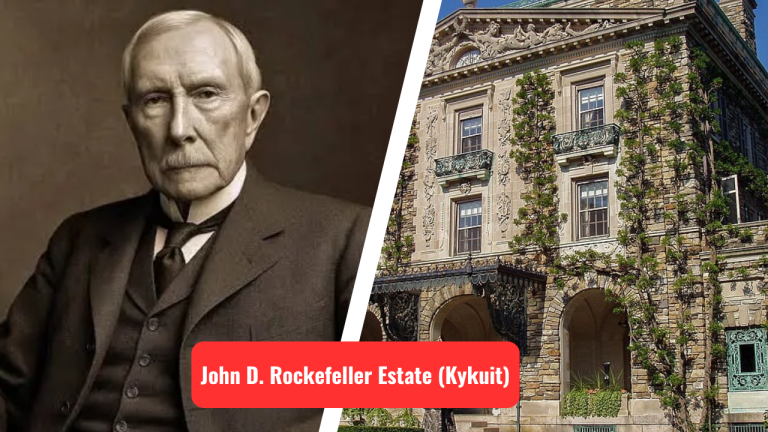
High above the Hudson River in Pocantico Hills, New York, Kykuit—better known as the John D. Rockefeller House—brings together architecture, landscape design, art and the history of one of America’s most influential families.A House Designed Around the LandscapeWhen people hear the name John D. Rockefeller, they often think first of Standard Oil, immense wealth and philanthropy. But his former country estate, Kykuit, offers a different way to understand his legacy: through architecture and the carefully planned relationship between a house, its gardens and its setting.Located in Pocantico Hills in Westchester County, New York, Kykuit occupies an elevated position overlooking the Hudson River and the Palisades. The name “Kykuit” comes from a Dutch word meaning “lookout,” an appropriate name for a residence whose location was chosen in part for its expansive views. The estate eventually became home to four generations of the Rockefeller family.Key Facts:Name: Kykuit, also known as the John D. Rockefeller EstateLocation: Pocantico Hills, Westchester County, New York, USACompleted: 1913Original architects: William A. Delano and Chester H. AldrichMajor architectural transformation: William Welles Bosworth, 1913Architectural character: Beaux-Arts with Colonial Revival/classical influencesLandscape architect: William Welles BosworthInterior designer: Ogden CodmanOriginal owner: John D. Rockefeller Sr.Family history: Home to four generations of RockefellersConstruction materials: Locally quarried rough-cut fieldstone and Indiana limestoneCurrent ownership: National Trust for Historic PreservationManagement: Rockefeller Brothers FundHistoric designation: Listed as a National Historic LandmarkArt collection: Includes historic decorative arts as well as 20th-century works associated with artists such as Pablo Picasso, Alexander Calder, Andy Warhol and Henry Moore.John D. Rockefeller Estate (Kykuit)From a Country Retreat to a Grand ResidenceThe story of Kykuit began before the present house existed. John D. Rockefeller Sr. started acquiring land around Pocantico Hills in 1893, attracted by its rolling terrain and elevated views. The setting offered something different from the rapidly developing urban environment of New York City—a private rural retreat surrounded by landscape.The first version of the main residence was designed in 1908 by the architectural partnership of William A. Delano and Chester H. Aldrich. Construction of the new Kykuit began in 1907, with the house completed in 1909. However, the building did not remain unchanged for long.John D. Rockefeller Jr. played an important role in developing the estate and wanted a residence and landscape that were more ambitious in scale and character. In 1913, architect William Welles Bosworth substantially altered the house, giving Kykuit much of the four-story Beaux-Arts appearance visitors recognize today.This evolution is important architecturally. Kykuit was not simply a wealthy family’s oversized country house; it became a carefully coordinated composition in which architecture, terraces, gardens, sculpture and views were treated as parts of one design.John D. Rockefeller Estate (Kykuit)The Architecture: Classical Elegance Rather Than ExcessDespite the extraordinary wealth of its owner, Kykuit does not depend on an overly ornate exterior to make an impression. Its architecture is restrained and classical, using rough-cut local fieldstone and Indiana limestone to create a substantial yet elegant exterior. The four-story composition reflects Bosworth’s classical vocabulary and Beaux-Arts training.The National Park Service records the Rockefeller Estate as having Colonial Revival and other architectural influences, with Delano & Aldrich and William Welles Bosworth identified as its principal architects.For architecture enthusiasts, one of the most interesting aspects of Kykuit is the balance between formal design and the natural landscape. The building sits on a hill rather than simply occupying the center of a flat lawn. This allowed the architects and landscape designers to use changes in level, terraces and long visual axes to extend the experience of the house far beyond its walls.John D. Rockefeller Estate (Kykuit)William Welles Bosworth and the Art of the GardenIf Kykuit is remembered for its architecture, its gardens are equally important.William Welles Bosworth designed the extensive formal gardens as a series of terraces adapted to the hilltop site. The design drew inspiration from Italian, French and English landscape traditions, creating a distinctly formal setting that takes advantage of the Hudson Valley landscape. Historical documentation describes the gardens as being organized around the north-south axis of the house, with terraces and paths designed to create changing views and places for enjoying the outdoors.The landscape includes fountains, sculpture, grottos, formal planting areas and architectural garden features. One of its notable elements is the Oceanus Fountain, commissioned in 1913 as a replica of a fountain created by Giambologna for Florence’s Boboli Gardens in the 16th century.This relationship between architecture and landscape is one of the strongest lessons Kykuit offers contemporary designers. Rather than treating the garden as decoration around a finished building, the estate was conceived as a continuous spatial experience.John D. Rockefeller Estate (Kykuit)Interiors by Ogden CodmanInside, the design moves from the rugged character of the exterior to a more refined decorative language. Ogden Codman was responsible for the neo-classical interiors, which incorporated English furnishings and an extensive collection of decorative objects.The interiors also reflect the collecting interests of the Rockefeller family. Chinese and European ceramics, family portraits and historical works formed part of the home’s collections.The result is a house where architecture and interiors work together without becoming completely detached from the building’s country-estate character. The restrained classical language creates a setting for furniture, art and objects collected by several generations of the family.When a Private Home Became an Art DestinationKykuit’s story did not end with John D. Rockefeller Sr. His descendants continued to shape the property, and the most significant transformation came through his grandson, Nelson A. Rockefeller.Nelson was a major supporter and collector of modern art. During the 1960s, he added galleries to Kykuit and introduced works by leading 20th-century artists. The collection eventually included artists such as Alexander Calder, Andy Warhol, Robert Motherwell, Henry Moore, Louise Nevelson and Pablo Picasso.Interestingly, the art was not confined to conventional gallery interiors. Sculptures were placed throughout the gardens, creating an unusual dialogue between contemporary art, classical landscape design and the surrounding countryside.That combination gives Kykuit much of its distinctive identity today. A visitor can encounter a formal Italian-inspired terrace and, within the same landscape, a work of modern sculpture. The contrast is deliberate rather than accidental.John D. Rockefeller Estate (Kykuit)More Than a Mansion: An Estate of Buildings and LandscapesIt is easy to focus on the main house, but Kykuit was part of a much larger working estate. The property included supporting buildings, gardens, greenhouses, carriage facilities and other structures necessary for maintaining an estate of this scale.The Coach Barn, for example, dates to the early 20th century and was later expanded to accommodate automobiles. The estate also included an orangerie and other landscape features. Today, these elements help explain how a large country estate functioned rather than presenting the house as an isolated architectural object.The National Park Service’s Historic American Buildings Survey also documents Kykuit and associated estate structures, providing valuable architectural records and historical drawings of the property.Preservation and the Rockefeller LegacyKykuit’s significance today extends beyond its association with one wealthy American family. The estate illustrates changing ideas about architecture, landscape design, collecting, philanthropy and historic preservation in the United States.In 1979, Nelson Rockefeller donated the Kykuit estate to the National Trust for Historic Preservation. The property is maintained and administered by the Rockefeller Brothers Fund as part of the Pocantico Center.The National Trust describes Kykuit as a place that helps tell the story of the Rockefeller family’s involvement in business, philanthropy, conservation, government and the arts. In this sense, the house functions as more than a preserved residence—it is a physical record of several generations and their changing interests.John D. Rockefeller Estate (Kykuit)Why Kykuit Still Matters to Architecture TodayFor architects and designers, Kykuit is particularly interesting because of its integrated approach to architecture and landscape.The house is impressive, but the real architectural lesson lies in the way its designers considered the entire site. The terraces respond to the slope, views are framed through carefully planned axes, garden structures create destinations, and sculpture becomes part of the landscape rather than simply an object placed inside a gallery.It also demonstrates how architecture can evolve. The house began with one architectural conception and was substantially transformed only a few years later. Instead of treating the original design as untouchable, the Rockefeller family commissioned a new architectural vision that better suited their ambitions for the estate.For today’s designers, Kykuit raises an enduring question: Should a landmark residence be designed as an object, or as an experience? At Kykuit, the answer is clearly the latter.A Living Record of Four GenerationsPerhaps the most fascinating aspect of the John D. Rockefeller House is that it cannot be understood through a single date, architect or style.John D. Rockefeller Sr. established the estate and its landscape. John D. Rockefeller Jr. pushed its development toward a more ambitious architectural and garden scheme. William Welles Bosworth gave the house and grounds their mature classical character. Ogden Codman shaped the interiors. Later, Nelson Rockefeller transformed parts of the property into spaces for modern art.The result is an architectural timeline contained within one estate.Kykuit therefore stands as an unusually rich example of American residential architecture—one where Gilded Age wealth, Beaux-Arts design, formal landscape architecture, historic interiors and modern art intersect in a single place.Visiting NoteKykuit’s public tours are on hiatus during 2026 while the visitor program is being redeveloped, with tours expected to resume in 2027. The Rockefeller Brothers Fund currently provides information about the property and its broader Pocantico historic sites. John D. Rockefeller Estate (Kykuit) John D. Rockefeller Estate (Kykuit) John D. Rockefeller Estate (Kykuit) John D. Rockefeller Estate (Kykuit) John D. Rockefeller Estate (Kykuit) John D. Rockefeller Estate (Kykuit) John D. Rockefeller Estate (Kykuit) John D. Rockefeller Estate (Kykuit) John D. Rockefeller Estate (Kykuit) Related Article:Inside Kumar Vishwas’ Luxurious Noida House: A Blend of Poetry, Art, and Palace-Style LivingGautam Adani House: Inside the luxurious residence of India’s business tycoon in AhmedabadMukesh Ambani House: Antilia, the world’s most expensive private residence in MumbaiJeff Bezos House: Inside the Mansions and Estates of the Amazon FounderBill Gates’s House: An inside look at all the homes owned by the Microsoft co-founderMichael Jordan’s homes: A design-led journey through his signature residencesJK House: Inside Gautam Singhania’s ₹6,000-crore skyscraper residence and is the second most expensive home after Mukesh Ambani’s AntiliaAbode: Inside Anil Ambani’s iconic Pali hill residence that redefines luxury living in MumbaiInside Jalsa: An architectural perspective on Amitabh Bachchan’s iconic Mumbai residenceAbode: Inside Anil Ambani’s iconic Pali hill residence that redefines luxury living in MumbaiJatia House: Kumar Mangalam Birla’s iconic home of luxury and heritage in MumbaiGulita: The diamond-inspired seafront mansion of Isha Ambani and Anand PiramalInside Sea Wind: The 17-Storey family home Mukesh Ambani shared with Anil Ambani before AntiliaInside ZOHO founder Sridhar Vembu’s house: A billionaire’s rural home built on vernacular architecture and sustainabilityGoolestan (Om Arc): Inside Anand Mahindra’s heritage home on Nepean sea road, MumbaiDeepinder Goyal House: Inside the Zomato Founder’s luxury home at DLF CamelliasBhavish Aggarwal house: Inside the Ola Co-founder’s Private Residence in BengaluruInside Sundar Pichai and Anjali Pichai’s House: A blend of modern luxury and thoughtful designSatya Nadella House: A Peek Inside the Microsoft CEO’s ResidenceAdar & Natasha Poonawalla’s Farmhouse: Inside a retreat of elegance and equestrian charmShiv Nadar’s Residence: Where art and vision shape the HCL founder’s homeNikhil Kamath House: Inside Zerodha co-founder’s luxury Bengaluru homeInside Anil Agarwal’s House: A look at the Vedanta billionaire’s London mansionRohini Nilekani and Nandan Nilekani House: A glimpse into the Bengaluru home of India’s tech visionaryUday Kotak House: Inside the iconic sea-Facing “Champagne House” in MumbaiSunil Bharti Mittal’s Mansion in Delhi: Inside a legacy home in India’s most exclusive addressInside Lakshmi Niwas Mittal’s global real estate empire: Steel, Success & Super HomesNithin Kamath House: A look inside the Zerodha CEO and founder’s lifestyle & design philosophyInside Savitri Jindal House: A Look at the Elegant Residences of India’s Richest WomanMamata Banerjee House: A look inside the modest home of Bengal’s CM residenceInside Pawan Kalyan’s Rs 130 Crore Jubilee Hills Mansion: A perfect blend of luxury and traditionPawan Kalyan’s new House at Pithapuram: Where architecture meets political identityInside CarryMinati’s House: Modern interiors, gaming studio & creator lifestyleSidhu Moose Wala House: Inside the Iconic Punjab mansion that became a landmark for fansInside Navjot Singh Sidhu’s Amritsar House: A ₹25 Crore mansion blending royal architecture and spiritual LivingAamir Khan House: A look inside the Bollywood Star’s elegant and minimalist homeTim Cook House: Inside Apple’s CEO’s private home and the philosophy behind itYohan & Michelle Poonawalla’s 7.5-Acre Koregaon Park Mansion: A grand blend of heritage, art, and luxuryDavid Warner House: Inside the Five-Level Oceanfront Sydney Home of Australia’s Cricket StarCristiano Ronaldo House: Inside the football legend’s stunning luxury homes around the worldVinod Khosla House: Arthur Erickson’s Concrete Retreat in Portola Valley