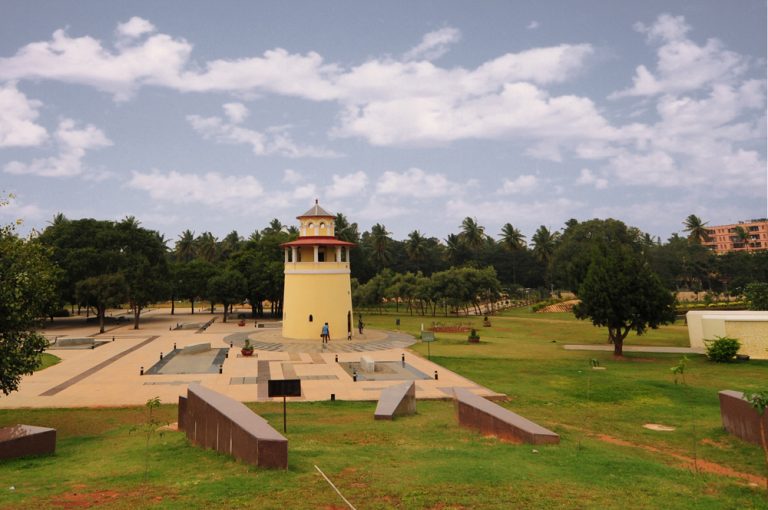
In the center of Bengaluru, surrounded by busy roads and government institutions, Freedom Park stands as one of the city’s most meaningful examples of adaptive reuse and urban transformation. What was once the historic Central Jail of Bangalore has now evolved into a public park, cultural venue, protest space, and memorial landscape.Unlike conventional city parks designed only for recreation, Freedom Park carries layers of political, historical, and architectural significance. Its preserved prison structures, watchtowers, and open gathering areas tell the story of Bengaluru’s colonial past while simultaneously functioning as a democratic public space in modern India.Today, Freedom Park is not just a green urban escape — it is a landmark where architecture, memory, heritage, and civic life intersect.Key Facts:Architect Firm: Mathew and Ghosh Architects (M & G)Architects: Nisha Mathew Ghosh & Soumitro GhoshProject: Freedom ParkClient: Bruhat Mahanagara PalikeYear Of Completion: 2011Site Area: 16.5 AcresBuilt Area: 3500 Sq Mts ApproximatelyLocated on Seshadri Road, Bengaluru, KarnatakaBuilt on the site of the former Bangalore Central JailCentral Jail originally constructed in 1862 during British ruleSpread across approximately 21 acresDesigned as an adaptive reuse and urban renewal projectFeatures preserved prison cells, watchtowers, and jail wallsIncludes an amphitheatre, exhibition spaces, library, and public plazaServes as Bengaluru’s designated protest and civic gathering spaceManaged by the Government of KarnatakaCombines heritage conservation with public landscape designFreedom Park in BangaloreHistorical BackgroundThe site that now houses Freedom Park originally functioned as the Bangalore Central Jail, established during the British colonial period in 1862. For more than a century, the prison remained one of Bengaluru’s most important correctional facilities.The jail complex witnessed several historical events, including the imprisonment of freedom fighters, political activists, and public figures. During India’s independence movement, many individuals associated with anti-colonial resistance were held within its walls, giving the site deep political significance.After the prison was decommissioned and relocated in 2000, discussions emerged regarding how the centrally located land should be used. Instead of demolishing the site entirely for commercial development, the Karnataka government chose to transform it into a public urban park that would preserve the memory of the former jail while serving contemporary civic needs.Freedom Park was officially inaugurated in 2008 as a symbol of democracy, public freedom, and urban heritage conservation.Freedom Park in BangaloreArchitectural Transformation and Adaptive ReuseOne of the most remarkable aspects of Freedom Park is its adaptive reuse approach. Rather than erasing the prison’s identity, architects and planners integrated many of the original structures into the new landscape design.The project preserves:Original prison barracksWatchtowersHigh stone wallsJail cellsEntry gates and circulation pathwaysThese historic elements were carefully retained and blended with landscaped gardens, open plazas, public gathering spaces, and cultural infrastructure.The result is a layered architectural environment where visitors can experience both the historical character of the prison and the openness of a contemporary urban park.This transformation demonstrates how adaptive reuse can preserve collective memory while giving old structures new social relevance.Spatial Planning and Public DesignFreedom Park is designed as a multifunctional public space rather than a conventional ornamental garden. The layout encourages movement, interaction, and public participation.The site includes large open lawns, shaded pathways, seating areas, exhibition galleries, and cultural performance spaces. One of the park’s most significant features is the amphitheatre, which hosts music performances, theatre productions, literary gatherings, and public discussions.Another important element is the designated protest zone. Similar to spaces like Jantar Mantar in Delhi, Freedom Park functions as Bengaluru’s officially recognized venue for demonstrations and civic protests. This role reinforces the park’s identity as a democratic urban space.The preserved watchtower acts as both a visual landmark and a symbolic reminder of the site’s past. From the top, visitors can view the changing urban fabric of Bengaluru surrounding the historic prison grounds.Freedom Park in BangaloreCultural and Civic ImportanceFreedom Park occupies a unique position in Bengaluru’s urban culture. It is simultaneously a memorial site, recreational landscape, heritage project, and political space.Over the years, the park has hosted:Public protests and demonstrationsTheatre performancesCultural festivalsPhotography exhibitionsBook fairs and literary eventsHeritage walksStudent gatherings and awareness campaignsThis continuous public engagement has helped Freedom Park remain active and relevant rather than becoming a static historical monument.Its role as a democratic gathering space is particularly significant in a rapidly urbanizing city where accessible public spaces are increasingly limited.Landscape and Environmental DesignThe landscape design of Freedom Park balances hard architectural remnants with soft green spaces. Lawns, trees, and shaded walkways soften the visual harshness of the old prison structures while creating a peaceful urban environment.The adaptive landscape approach also contributes to environmental sustainability by reusing existing built infrastructure instead of relying on complete demolition and reconstruction.Open spaces within the park improve urban breathing room in central Bengaluru, offering residents a rare combination of heritage and greenery within a dense city environment.Freedom Park in BangaloreArchitectural Significance in BengaluruFreedom Park is widely regarded as one of Bengaluru’s most successful examples of heritage conservation through adaptive reuse. Instead of treating the prison as a structure to be erased, the project transformed it into a space of openness and public participation.Architecturally, the park reflects how cities can reinterpret difficult or restrictive historical sites into inclusive civic environments. The contrast between prison architecture and open public landscapes creates a powerful spatial narrative about freedom, memory, and urban evolution.The project also demonstrates the importance of preserving historical layers within rapidly developing Indian cities.Freedom Park is more than just an urban park in Bengaluru. It is a living example of how architecture and landscape design can transform spaces associated with confinement into places of freedom, culture, and civic expression.By preserving the memory of the old Central Jail while creating an accessible public environment, Freedom Park bridges Bengaluru’s colonial past with its contemporary urban identity.Its historical depth, adaptive reuse strategy, and ongoing civic relevance make it one of the most important public spaces in Bengaluru and a significant case study in urban heritage conservation in India. Freedom Park in Bangalore Freedom Park in Bangalore Freedom Park in Bangalore Freedom Park in Bangalore Freedom Park in Bangalore Freedom Park in Bangalore Related Article:Puja Casa, Bandra: Inside a contemporary luxury residence in Mumbai’s prestigious Pali HillOmkar 1973 Worli: Inside Mumbai’s iconic luxury skyscraper by Foster + PartnersRustomjee Crown: A new benchmark for luxury living in South MumbaiRaheja Artesia, Worli: Inside Mumbai’s most exclusive ultra-luxury residential towerBeauMonde Towers, Prabhadevi: Inside Mumbai’s most coveted luxury address – Architecture, amenities, celebrities & key factsDLF Camellias: Inside India’s most luxurious residential address