Soujanya House
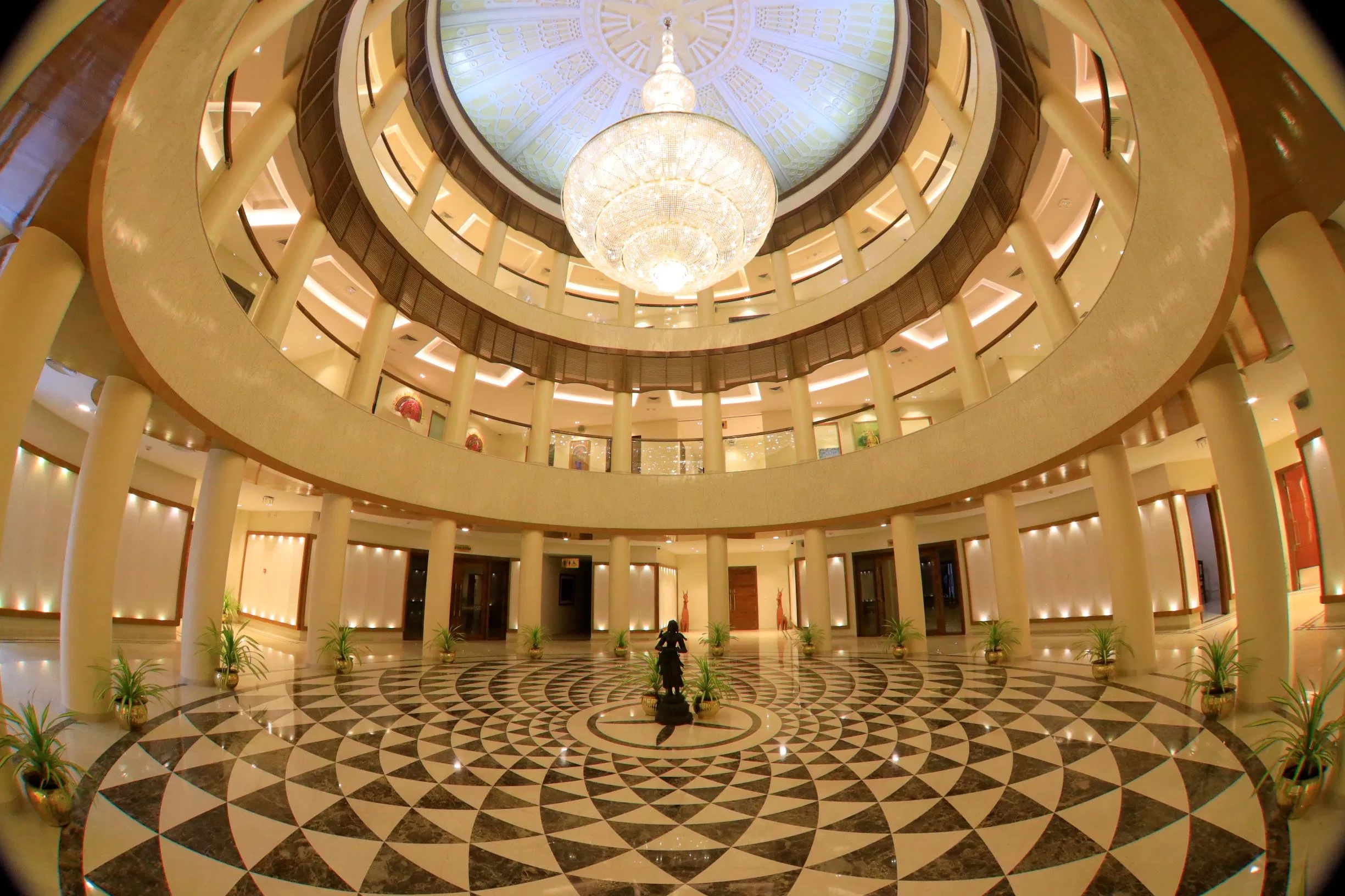
In the evolving architectural landscape of Kolkata, Soujanya House has emerged as a symbol of governmental authority, hospitality, and understated luxury. Conceived as a high-security state guest residence for hosting dignitaries and senior government officials, the complex reflects a contemporary interpretation of institutional architecture—formal in geometry, restrained in ornamentation, yet deeply rooted in the cultural temperament of Bengal.
Recently brought into the political spotlight due to reports that West Bengal Chief Minister Suvendu Adhikari may shift to the complex in Alipore, Soujanya House has once again become a subject of public and architectural interest.
A State Residence Designed for Governance
Located in Kolkata’s prestigious Alipore district, Soujanya House was designed as an official state guest house intended to accommodate VIPs, dignitaries, and important guests of the Government of West Bengal. The project was developed for NBCC India Ltd. and designed by GPM Architects & Planners
According to the architects, the project sought to represent “Kolkata’s humility as well as opulence” through a balanced architectural language. Rather than relying on excessive grandeur, the design uses geometry, proportion, and spatial organization to communicate institutional authority.
Key Facts:
- Project Name: Soujanya House
- Location: Alipore, Kolkata, West Bengal, India
- Architect: GPM Architects & Planners
- Client: NBCC India Ltd.
- Function: State guest house / VIP residence
- Site Area: 2.7 acres
- Built-up Area: Approximately 100,000 sq. ft.
- Status: Built and operational
- Architectural Language: Geometry, Symmetry and Authority
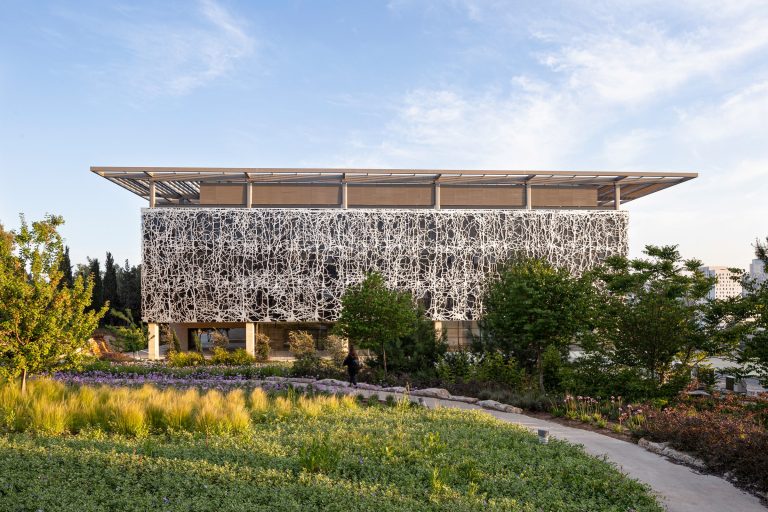
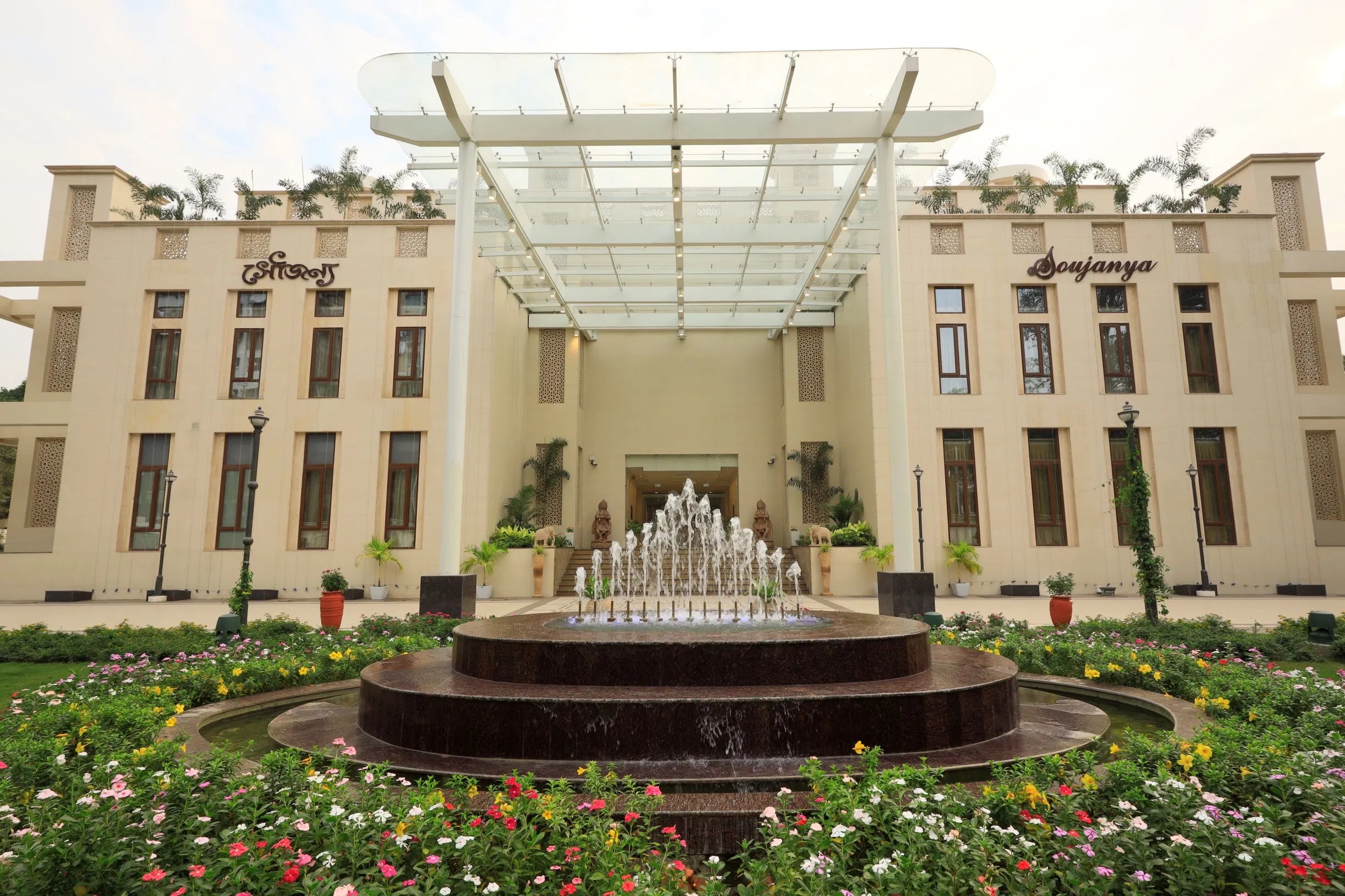
The defining characteristic of Soujanya House is its geometric discipline. The building employs a symmetrical layout both in plan and elevation, reinforcing the sense of institutional order associated with government architecture.
The facade remains intentionally restrained. Large planar surfaces are punctuated with trellis screens and rhythmic openings that reduce visual monotony while also responding to Kolkata’s climatic conditions. This controlled use of texture and shadow creates a contemporary civic identity without abandoning regional sensibilities.
Unlike many monumental government buildings that rely heavily on classical ornamentation, Soujanya House adopts a quieter modernist approach. The structure communicates power through scale and composition rather than decorative excess.
Interior Design Approach
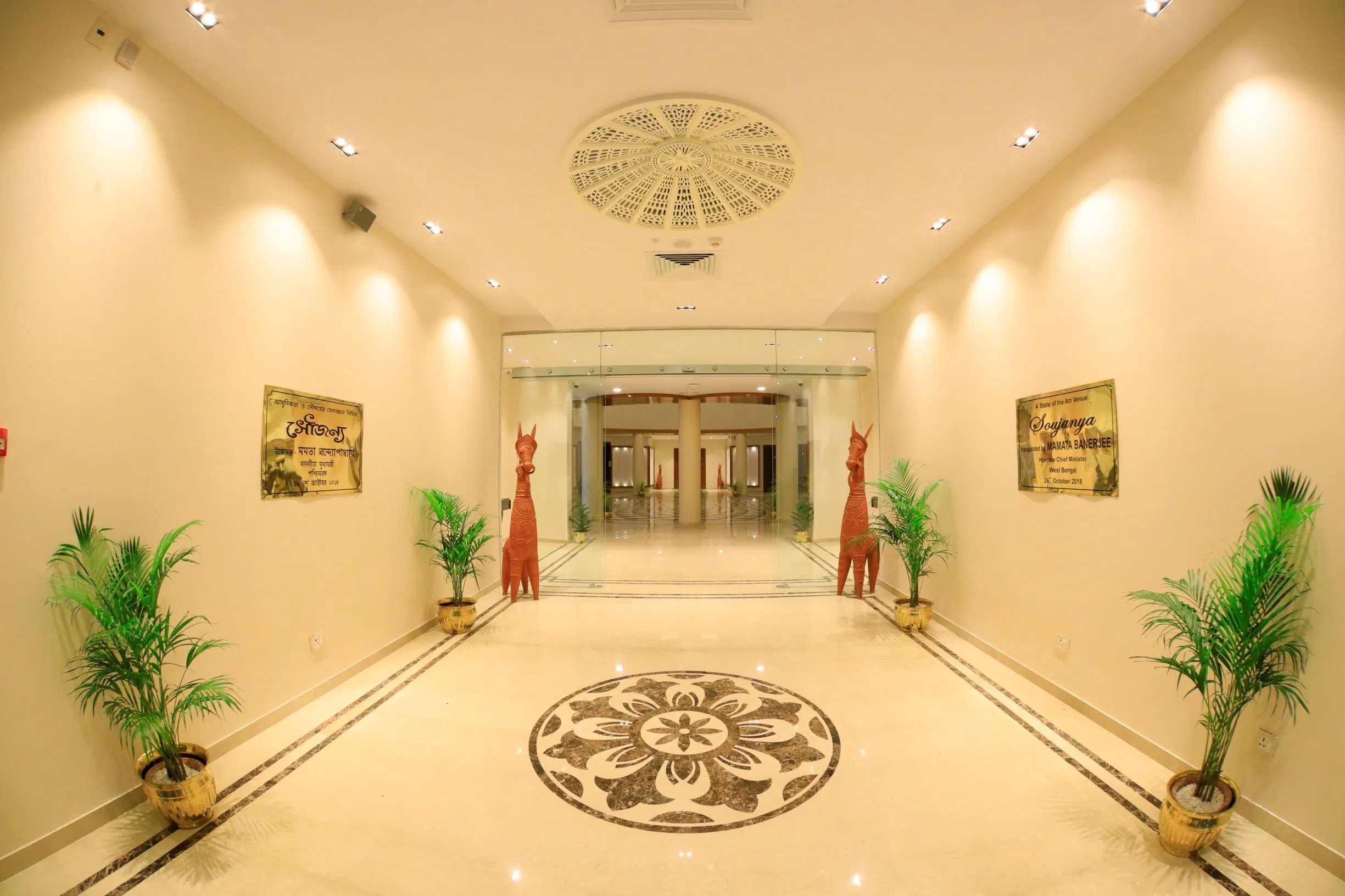
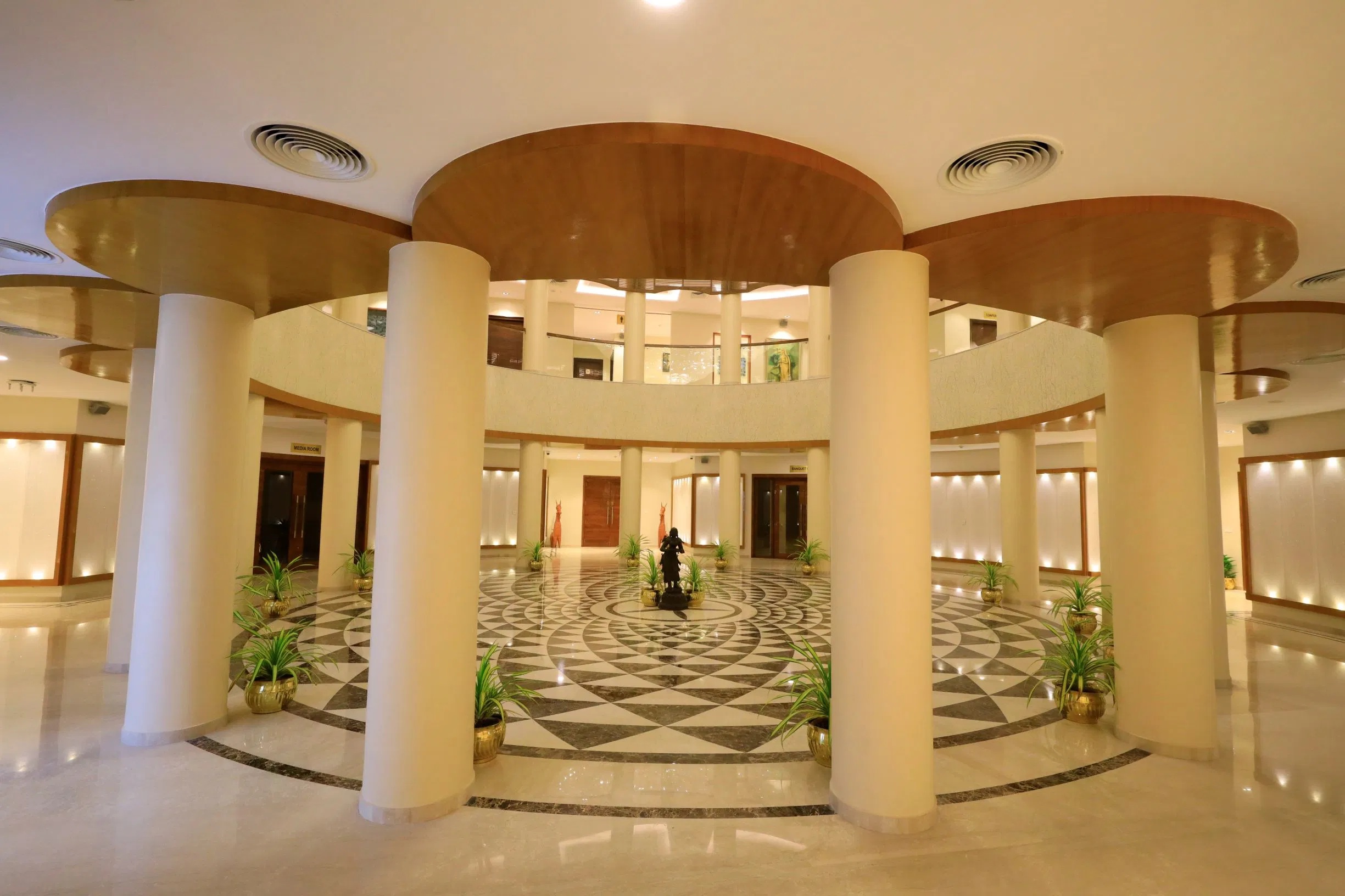
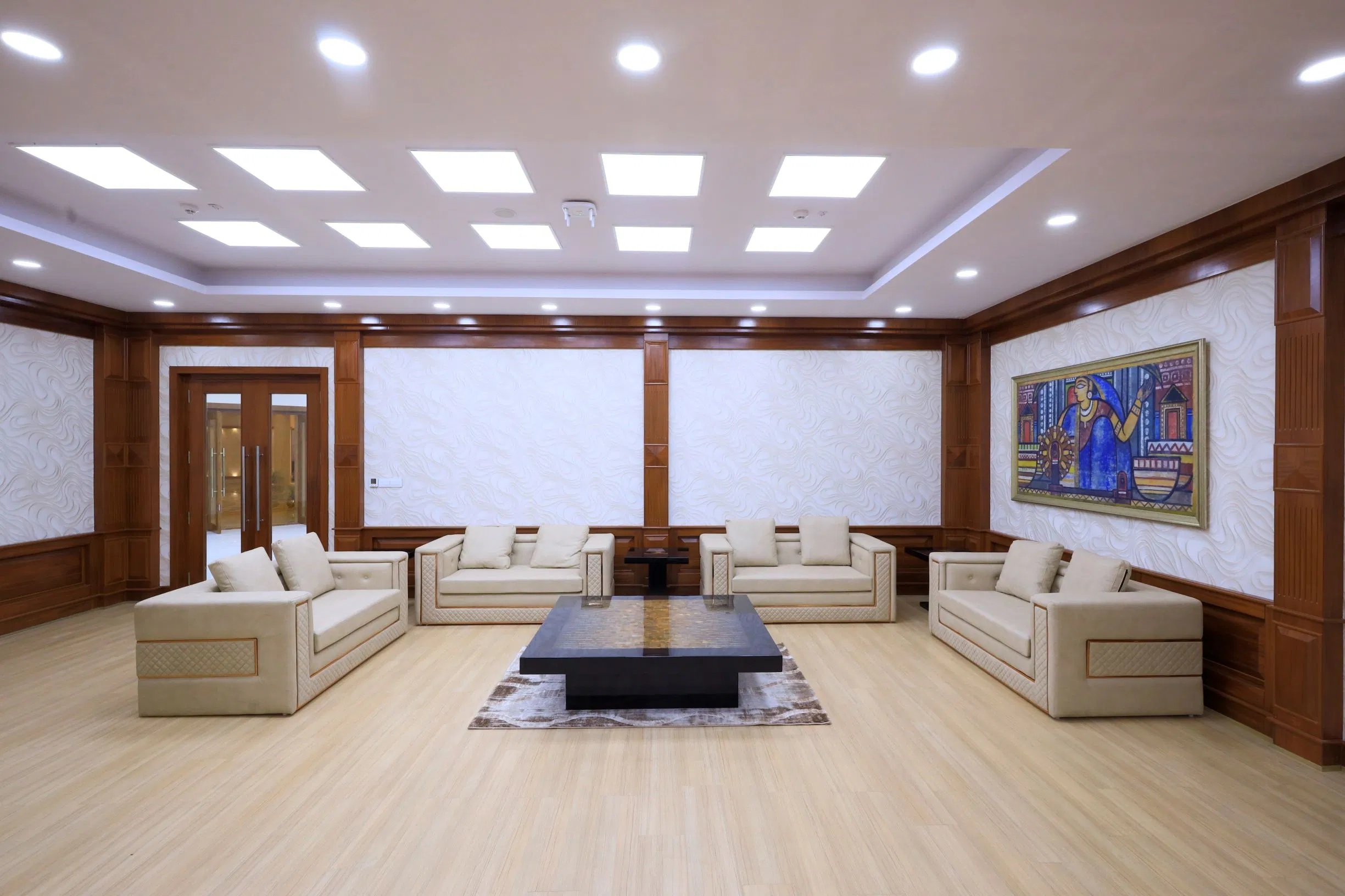
The interiors follow a muted monochromatic palette designed to evoke calmness and formality. Neutral tones dominate the spaces, while darker furniture and flooring accents provide contrast and visual hierarchy. The architects describe the interior strategy as intentionally “simple” and “humble,” aligning with the cultural ethos of Kolkata.
Landscape and Spatial Planning
One of the lesser-discussed yet significant aspects of Soujanya House is its landscape planning. The complex is organized through a geometric landscape framework that not only creates ceremonial vistas but also regulates circulation and vehicular movement within the campus.
The planning reflects the dual requirements of:
- high-security governmental operations,
- and hospitality-oriented spatial experience.
This combination is particularly important for residences meant for state dignitaries, where protocol, security, accessibility, and visual dignity must coexist seamlessly.
Political Significance and Recent Attention
Soujanya House entered mainstream national discussion after reports indicated that Chief Minister Suvendu Adhikari may relocate there from his Chinar Park residence. Media reports describe the complex as one of Kolkata’s most secure and strategically important VIP residential facilities.
Its location is particularly notable because it lies close to former Chief Minister Mamata Banerjee’s Kalighat residence, adding a symbolic political dimension to the move.
While the residence was originally envisioned as a dignitary guest house, its potential role as the official residence of a sitting Chief Minister elevates its stature within Bengal’s contemporary political geography.
Soujanya House in Kolkata’s Architectural Context
Kolkata is globally recognized for its colonial-era civic architecture, neoclassical mansions, and institutional buildings. In contrast, Soujanya House represents a newer layer of governmental architecture emerging in the city—minimal, secured, infrastructurally efficient, and contemporary in expression.
Rather than imitating the ornate language of colonial state buildings such as Writers’ Building or Raj Bhavan, Soujanya House reflects the evolution of Indian administrative architecture toward controlled modernism. Its aesthetic lies in proportion, spatial clarity, and disciplined landscaping rather than visual extravagance.
This shift mirrors broader architectural trends across Indian state infrastructure projects, where functionality, security, and symbolic authority increasingly shape design decisions.
Why Soujanya House Matters
Soujanya House is more than a government residence. It is a case study in how contemporary Indian civic architecture negotiates:
- political symbolism,
- regional identity,
- security requirements,
- and modern institutional aesthetics.
At a time when many public buildings either replicate historical styles or pursue aggressively globalized glass architecture, Soujanya House occupies a middle ground—formal yet contextual, monumental yet restrained.
Its growing political visibility may further cement its place in discussions around contemporary architecture in Bengal.










Related Article:
Gautam Adani House: Inside the luxurious residence of India’s business tycoon in Ahmedabad
Mukesh Ambani House: Antilia, the world’s most expensive private residence in Mumbai
Jeff Bezos House: Inside the Mansions and Estates of the Amazon Founder
Bill Gates’s House: An inside look at all the homes owned by the Microsoft co-founder
Michael Jordan’s homes: A design-led journey through his signature residences
Abode: Inside Anil Ambani’s iconic Pali hill residence that redefines luxury living in Mumbai
Inside Jalsa: An architectural perspective on Amitabh Bachchan’s iconic Mumbai residence
Abode: Inside Anil Ambani’s iconic Pali hill residence that redefines luxury living in Mumbai
Jatia House: Kumar Mangalam Birla’s iconic home of luxury and heritage in Mumbai
Gulita: The diamond-inspired seafront mansion of Isha Ambani and Anand Piramal
Inside Sea Wind: The 17-Storey family home Mukesh Ambani shared with Anil Ambani before Antilia
Goolestan (Om Arc): Inside Anand Mahindra’s heritage home on Nepean sea road, Mumbai
Deepinder Goyal House: Inside the Zomato Founder’s luxury home at DLF Camellias
Bhavish Aggarwal house: Inside the Ola Co-founder’s Private Residence in Bengaluru
Inside Sundar Pichai and Anjali Pichai’s House: A blend of modern luxury and thoughtful design
Satya Nadella House: A Peek Inside the Microsoft CEO’s Residence
Adar & Natasha Poonawalla’s Farmhouse: Inside a retreat of elegance and equestrian charm
Shiv Nadar’s Residence: Where art and vision shape the HCL founder’s home
Nikhil Kamath House: Inside Zerodha co-founder’s luxury Bengaluru home
Inside Anil Agarwal’s House: A look at the Vedanta billionaire’s London mansion
Uday Kotak House: Inside the iconic sea-Facing “Champagne House” in Mumbai
Sunil Bharti Mittal’s Mansion in Delhi: Inside a legacy home in India’s most exclusive address
Inside Lakshmi Niwas Mittal’s global real estate empire: Steel, Success & Super Homes
Nithin Kamath House: A look inside the Zerodha CEO and founder’s lifestyle & design philosophy
Inside Savitri Jindal House: A Look at the Elegant Residences of India’s Richest Woman
Mamata Banerjee House: A look inside the modest home of Bengal’s CM residence