

Leaning Tower of Pisa and Ratneshwar Mahadev Temple
Across the world’s architectural heritage, few structures capture popular imagination like monuments that defy straight lines. The Leaning Tower of Pisa in Italy is globally renowned — an iconic campanile that leans due to centuries-old soil settlement. Less known internationally but equally captivating is India’s Ratneshwar Mahadev Temple in Varanasi, a leaning Hindu shrine whose tilt rivals — and even exceeds — that of Pisa’s famous tower. This article delves deep into both, tracing their history, architecture, causes of tilt, cultural significance, and fascinating myths that surround them.
Part I — The Leaning Tower of Pisa: An Architectural Marvel of Medieval Europe
Historical Background
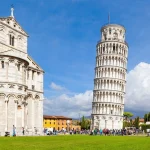
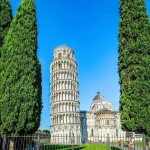
The Leaning Tower of Pisa (Italian: Torre di Pisa or Torre Pendente di Pisa) is one of the most iconic architectural landmarks in the world. It stands in the Piazza dei Miracoli (Square of Miracles) in Pisa, Tuscany, Italy. Conceived as the freestanding bell tower (campanile) for Pisa’s cathedral, construction began on 9 August 1173, during a period of wealth and prominence for the maritime Republic of Pisa.
Construction took nearly 200 years, proceeding in stages with lengthy interruptions due to wars among Italian city-states. The tower was finally completed in 1372 with its bell chamber, culminating a long medieval project involving multiple architects and engineers.
Design & Architecture
The tower’s architectural style is Romanesque, characterized by rounded arches, balanced symmetry, and classical columns. Built primarily from white marble and other stones, its eight stories feature arcades and galleries that showcase medieval craftsmanship and aesthetic principles.
- Height: Approximately 55.86 m on the low side and 56.67 m on the high side
- Floors: Eight stories with 294–296 steps
- Material: Marble and stone
- Function: Bell tower for Pisa Cathedral
- Bells: Seven bells, each tuned to a musical note

Why It Leans
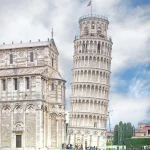
The most enduring mystery — and fame — of the Tower of Pisa lies in its tilt. A few years after construction began, builders noticed the structure sagging due to the soft, unstable soil beneath it. Rather than solid rock, the ground consisted of sand, clay, and silt, unable to support such a massive structure.
This uneven settling began as early as 1178, when only the second floor had been completed, and worsened as construction continued. Builders attempted to compensate by adjusting the heights of upper floors, which resulted in a noticeable curvature rather than pure tilt.
Engineering & Stabilization
Over centuries, the tower’s lean increased. By the late 20th century, it reached about 5.5 degrees, raising serious concerns about collapse. Extensive engineering work between 1990 and 2001 stabilized the foundation by removing soil beneath one side and adding counterweights, reducing the lean to less than 4 degrees — a level expected to keep the structure stable for at least several centuries.
Today, the Leaning Tower of Pisa remains a UNESCO World Heritage Site and attracts millions of visitors annually, symbolizing human ingenuity and historical persistence.

Part II — Ratneshwar Mahadev Temple: India’s Lesser-Known Leaning Marvel
Location & Cultural Context
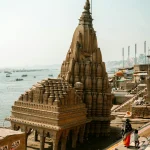
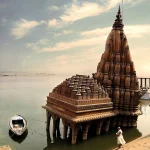
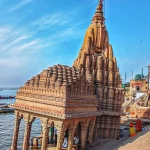
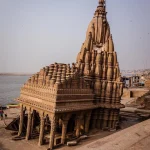
The Ratneshwar Mahadev Temple stands at Manikarnika Ghat in Varanasi (ancient Kashi), Uttar Pradesh, India’s holiest riverfront known for its deep religious significance and centuries-old Hindu rituals.
Dedicated to Lord Shiva, one of Hinduism’s principal deities, the temple is often visually remarkable due to its unusual tilt and low placement near the banks of the Ganges River.
Historical Background & Construction
The exact origins of the Ratneshwar Mahadev Temple are shrouded in both legend and historical ambiguity:
- Local revenue records suggest it was constructed between 1825 and 1830.
- Some historians believe it was built by the Amethi royal family in the 19th century.
- Other stories attribute its construction to Queen Baija Bai of Gwalior or associates of Ahilya Bai Holkar.
Despite its relatively recent age compared to medieval European monuments, historical sketches from the early 19th century by British antiquarian James Prinsep show that the temple’s entrance was once underwater and priests would dive into the river for worship — hinting at its unique riverside placement.

Architecture & Unique Site Features
Unlike typical North Indian temples, Ratneshwar Mahadev was built at an unusually low level, such that its sanctum sanctorum (garbhagriha) remains submerged for much of the year when the river rises, emerging only in the late summer after the monsoon has receded.
Architecturally, it follows the Nagara style, featuring a classic shikhara (spire) above the sanctum and a mandapa (pillared hall) — yet its most striking feature is its pronounced lean.
Why It Leans — Science and Legend
The temple leans at an estimated nine degrees, which is greater than the stabilized lean of the Tower of Pisa (less than four degrees).

Scientific explanations point to:
- A poor foundation built on river-deposited silt and unstable soil.
- Constant erosion and shifting water levels exerting uneven pressure on the base.
- Possible changes in the adjacent ghat platforms over time, raising surrounding levels while the temple’s base remained low.
Myths and folklore enrich the temple’s narrative:
- One popular legend tells of a servant who built the temple for his mother, Ratna Bai, and claimed to have repaid his maternal debt — only for the temple to tilt immediately as a symbolic reprimand, since a mother’s debt can never be fully repaid.
- Another legend speaks of a servant of Ahilya Bai Holkar who named the temple after himself, leading to a curse and ensuing tilt.
Whether explained by geology or folklore, the effect is visually compelling and spiritually evocative.
Comparative Insight: Pisa Tower vs. Ratneshwar Mahadev Temple

Cultural & Architectural Significance
For Pisa
The Leaning Tower remains an enduring symbol of medieval engineering — a testament to how human creativity and adaptation can turn structural mistakes into defining beauty. Its tilt, rather than undermining its value, has cemented its place in global cultural imagination and tourism.
For Varanasi
Ratneshwar Mahadev Temple stands as a poignant reminder of India’s living traditions where architecture, myth, and spiritual symbolism interweave. Built at river’s edge, baptized endlessly by the Ganges’ rising waters, and leaning silently over centuries, it embodies devotion as much as architectural enigma.
In comparing these two extraordinary leaning structures, we discover that architectural quirks are not just accidents but stories — narratives of humanity, faith, environment, and time. Whether in the heart of Tuscany or on the sacred ghats of Varanasi, these tilted wonders continue to fascinate, inspire, and remind us that history often reveals its most compelling truths in the most unexpected ways.

Related Article:
Puja Casa, Bandra: Inside a contemporary luxury residence in Mumbai’s prestigious Pali Hill
Gautam Adani House: Inside the luxurious residence of India’s business tycoon in Ahmedabad
Mukesh Ambani House: Antilia, the world’s most expensive private residence in Mumbai
Jeff Bezos House: Inside the Mansions and Estates of the Amazon Founder
Bill Gates’s House: An inside look at all the homes owned by the Microsoft co-founder
Michael Jordan’s homes: A design-led journey through his signature residences
Abode: Inside Anil Ambani’s iconic Pali hill residence that redefines luxury living in Mumbai
Inside Jalsa: An architectural perspective on Amitabh Bachchan’s iconic Mumbai residence
Abode: Inside Anil Ambani’s iconic Pali hill residence that redefines luxury living in Mumbai
Jatia House: Kumar Mangalam Birla’s iconic home of luxury and heritage in Mumbai
Gulita: The diamond-inspired seafront mansion of Isha Ambani and Anand Piramal
Inside Sea Wind: The 17-Storey family home Mukesh Ambani shared with Anil Ambani before Antilia
Goolestan (Om Arc): Inside Anand Mahindra’s heritage home on Nepean sea road, Mumbai