

Pataudi Palace
Located amid the quiet countryside of Haryana, about 25 kilometers from Gurugram, Pataudi Palace stands as one of India’s finest examples of early 20th-century colonial architecture infused with princely grandeur. Also known as Ibrahim Kothi, the palace is not only a royal residence but a layered architectural narrative that reflects India’s transition from princely states to modern nationhood.
Built in 1935, Pataudi Palace was commissioned by Nawab Iftikhar Ali Khan, the eighth Nawab of Pataudi and a prominent sportsman who captained the Indian cricket team. The palace was conceived as a statement of status, modernity, and cultural refinement, at a time when Indian royalty was negotiating its place within the British colonial framework.
Architectural Vision and Design
The palace was designed by Sir Robert Tor Russell, a well-known British architect whose works include New Delhi’s Connaught Place and several iconic colonial structures. At Pataudi, Russell employed a restrained yet elegant architectural language that blended colonial classicism with Indo-Saracenic influences.
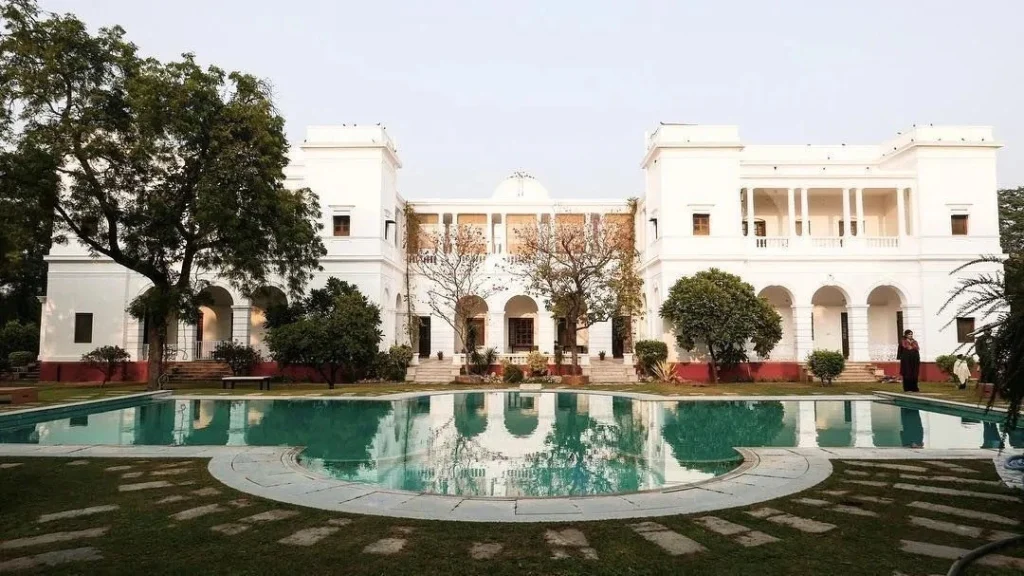
The building is symmetrical in plan, organized around a strong central axis. It rises to multiple levels, with a commanding central dome flanked by smaller cupolas, lending the palace a stately skyline. Wide colonnades, arched verandas, and high ceilings were designed not only for visual grandeur but also to respond to the region’s climate by promoting ventilation and shade.
The façade is finished in soft earthy tones, allowing the palace to merge gracefully with its surroundings. Unlike overly ornate palaces of earlier periods, Pataudi Palace reflects a shift toward understated elegance, favoring proportion, balance, and spatial clarity over excessive decoration.
Key facts of Pataudi Palace:
Architect: Robert Tor Russell assisted by Karl Molt Von Heinz
Location: Pataudi, Gurugram, Haryana
Completed: 1935
Client: Iftikhar Ali Khan
Owner: Saif Ali Khan
Management: Pataudi family
Engineer: Dilip Kumar
Price: Approximately Rs 800 crores (Source: Hindustan Times)
Size: 10 Acres
Rooms: 150 rooms

Spatial Planning and Interiors
Pataudi Palace originally housed nearly 150 rooms, including grand durbar halls, private apartments, guest rooms, libraries, and service quarters. The interior layout followed a hierarchical planning system typical of princely residences, with public spaces on the lower levels and private family areas above.
Large reception halls feature high ceilings, classical columns, and polished stone floors. Fireplaces, wooden staircases, and long corridors echo British country house aesthetics, while subtle Indian elements appear in decorative motifs, textiles, and artworks.
One of the most distinctive aspects of the interiors is the extensive display of family memorabilia—vintage photographs, trophies, books, and hunting relics—offering insight into the lifestyle of the Pataudi family. These elements transform the palace from a static monument into a living archive of personal and national history.
Landscape and Setting
The palace is set within approximately 10 acres of landscaped grounds, originally planned to complement the architectural symmetry of the building. Lawns, tree-lined pathways, and open courtyards create a sense of openness and retreat. The positioning of the palace on slightly elevated ground enhances its visual dominance while maintaining harmony with the rural landscape.
The relationship between built form and open space is a key architectural strength. The palace does not overwhelm its site; instead, it anchors it, creating a calm, almost contemplative environment that contrasts with the dense urban fabric of nearby cities.
Historical Transitions
Following Indian independence and the abolition of princely privileges, maintaining such a vast property became increasingly challenging. By the late 20th century, portions of the palace fell into disuse. In the early 2000s, Saif Ali Khan, heir to the Pataudi family, initiated a comprehensive restoration of the palace.
The restoration was undertaken with sensitivity to the original design, retaining architectural integrity while adapting the structure for contemporary use. In partnership with Neemrana Hotels, Pataudi Palace was converted into a heritage hotel, allowing the building to remain economically viable while preserving its historic character.
Adaptive Reuse as a Heritage Hotel
Today, Pataudi Palace functions as a luxury heritage property, offering guests an immersive experience of royal living. The adaptive reuse demonstrates how historic structures can be preserved through thoughtful modernization. Modern amenities were discreetly integrated without altering the palace’s essential architectural identity.
Guest rooms were created from former private chambers, while public halls were repurposed as lounges, dining areas, and event spaces. The transformation respects the original spatial hierarchy and avoids intrusive structural changes, making it a strong example of adaptive reuse in Indian heritage architecture.

Cultural and Architectural Significance
Pataudi Palace occupies a unique position in India’s architectural landscape. It represents a moment when Indian royalty embraced European design principles while maintaining cultural individuality. Unlike medieval forts or highly ornamented palaces, Pataudi is a product of the late colonial period, reflecting changing tastes, political realities, and lifestyles.
Architecturally, it stands as an example of how classical symmetry and climatic responsiveness can coexist. Culturally, it bridges multiple identities—royal, colonial, national, and contemporary—making it relevant beyond its immediate historical context.
Pataudi Palace is more than a royal residence or luxury hotel; it is a case study in architectural evolution, cultural adaptation, and heritage conservation. Its clean lines, balanced proportions, and thoughtful integration with the landscape make it a landmark of early modern Indian palace architecture.
For architects, historians, and design enthusiasts, the palace offers valuable lessons in contextual design, adaptive reuse, and long-term sustainability of heritage structures. As cities expand and historic buildings face increasing pressure, Pataudi Palace stands as a reminder that preservation and progress can coexist when guided by respect for history and design intelligence.


Related Article:
Elon Musk’s Houses: Tour the Stunning Homes Owned by the Tesla Billionaire
Mark Zuckerberg’s Houses: An Inside Look at the Luxurious Homes of Facebook’s Founder
Gautam Adani House: Inside the luxurious residence of India’s business tycoon in Ahmedabad
Mukesh Ambani House: Antilia, the world’s most expensive private residence in Mumbai
Jeff Bezos House: Inside the Mansions and Estates of the Amazon Founder
Bill Gates’s House: An inside look at all the homes owned by the Microsoft co-founder
Michael Jordan’s homes: A design-led journey through his signature residences
Abode: Inside Anil Ambani’s iconic Pali hill residence that redefines luxury living in Mumbai
Inside Jalsa: An architectural perspective on Amitabh Bachchan’s iconic Mumbai residence