Vishwa Shanti Stupa, Rajgir
Perched atop the picturesque Ratnagiri Hills in Rajgir, Bihar, the Vishwa Shanti Stupa, also known as the World Peace Pagoda, is much more than a religious monument. It is an architectural expression of peace, compassion and the timeless teachings of Gautama Buddha.
Rising above the green landscape at approximately 400 metres, this magnificent white stupa creates a striking visual connection between architecture, nature and spirituality. Its gleaming marble surfaces, golden Buddha sculptures and distinctive Buddhist form make it one of the most recognisable landmarks of Bihar.
Inaugurated in 1969, the monument was conceived as part of an international peace movement initiated by Japanese Buddhist monk Nichidatsu Fujii (Fuji Guruji). Today, it stands as a reminder that architecture can transcend its physical purpose and become a medium for communicating universal human values.
For architecture enthusiasts, the Vishwa Shanti Stupa is particularly interesting because of its combination of traditional Buddhist symbolism, Japanese spiritual influence, monumental scale and sensitive hilltop setting.
Key facts:
- Project Name: Vishwa Shanti Stupa (World Peace Pagoda)
- Location: Ratnagiri Hill, Rajgir, Nalanda district, Bihar, India.
- Architectural Style: Buddhist Stupa architecture with Japanese Buddhist influence.
- Concept & Vision: Most Ven. Nichidatsu Fujii (Fuji Guruji), Japanese Buddhist monk.
- Builder / Organisation: Nipponzan Myohoji Buddhist Organisation.
- Architect: Traditional Buddhist architectural design.
- Foundation Stone: Laid in 1965 by Dr. Sarvepalli Radhakrishnan, President of India.
- Year of Completion: 1969.
- Inauguration: 25 October 1969 by President V. V. Giri.
- Construction Materials: White marble and concrete.
- Height: Approximately 125–129 feet.
- Site Elevation: Approximately 400 metres above sea level.
- Key Architectural Feature: Four golden Buddha statues representing birth, enlightenment, first sermon and Mahaparinirvana.
- Structural Form: Circular dome with an ornamental spire and surrounding terraces.
- Accessibility: Rajgir ropeway and pedestrian staircase.
- Purpose: Promoting world peace, non-violence, Buddhist philosophy and international harmony.
1. Historical background: A vision born from the pursuit of peace
The story of the Vishwa Shanti Stupa begins with a vision that extended far beyond India. Its origins are associated with Japanese Buddhist monk Nichidatsu Fujii, popularly known as Fuji Guruji, who dedicated his life to spreading the message of peace and non-violence.
Deeply affected by the devastation caused by the atomic bombings of Hiroshima and Nagasaki during the Second World War, Fuji Guruji initiated a movement to establish Peace Pagodas across the world. The idea was simple yet powerful: create monuments that would encourage humanity to move beyond conflict and embrace compassion.
Rajgir became an important destination for this international movement because of its deep association with Gautama Buddha.
The foundation stone of the Vishwa Shanti Stupa was laid in 1965 by Dr Sarvepalli Radhakrishnan, the then President of India. After four years of construction, the monument was inaugurated on 25 October 1969 by President V. V. Giri.
The project also represents a significant cultural connection between India and Japan, bringing together Buddhist traditions, spiritual leadership and international cooperation.
2. Architectural design: The language of the Buddhist stupa
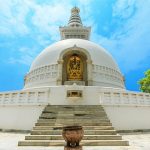
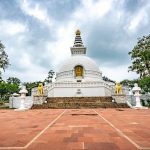
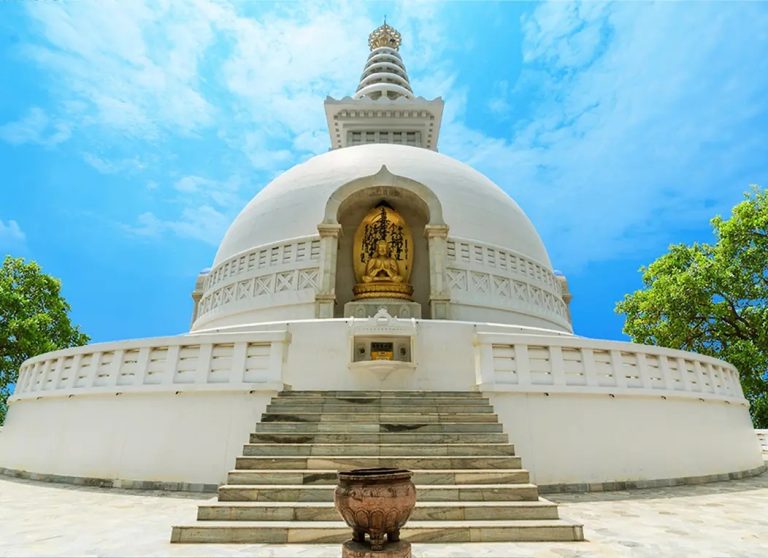
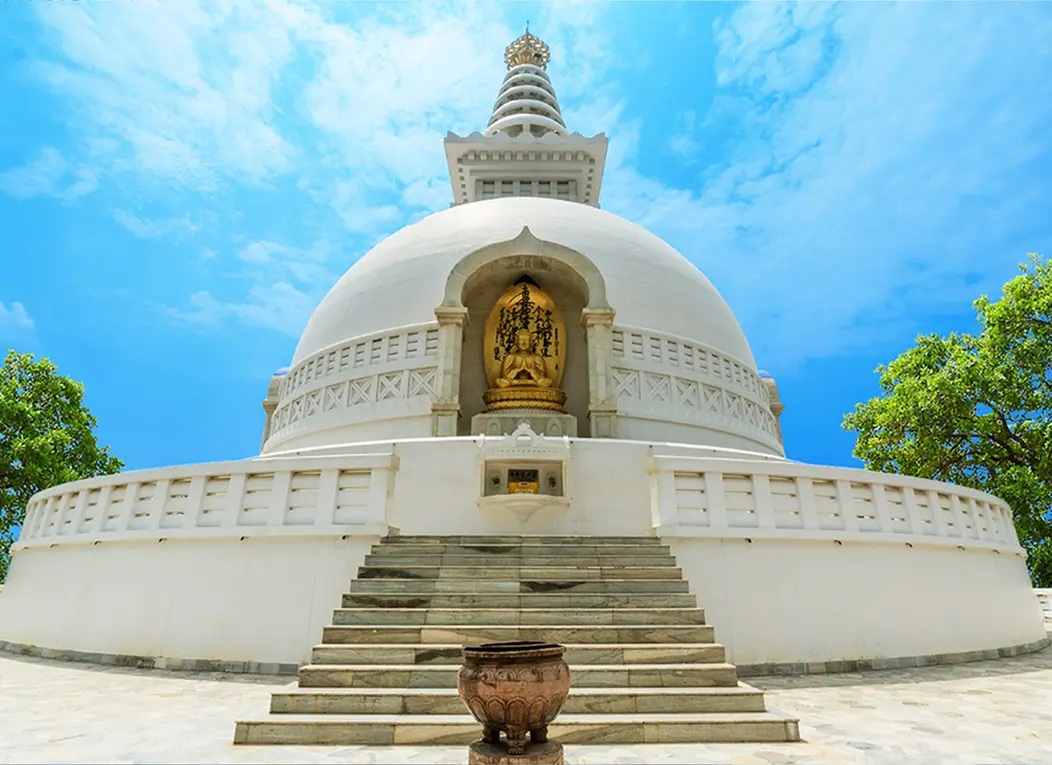
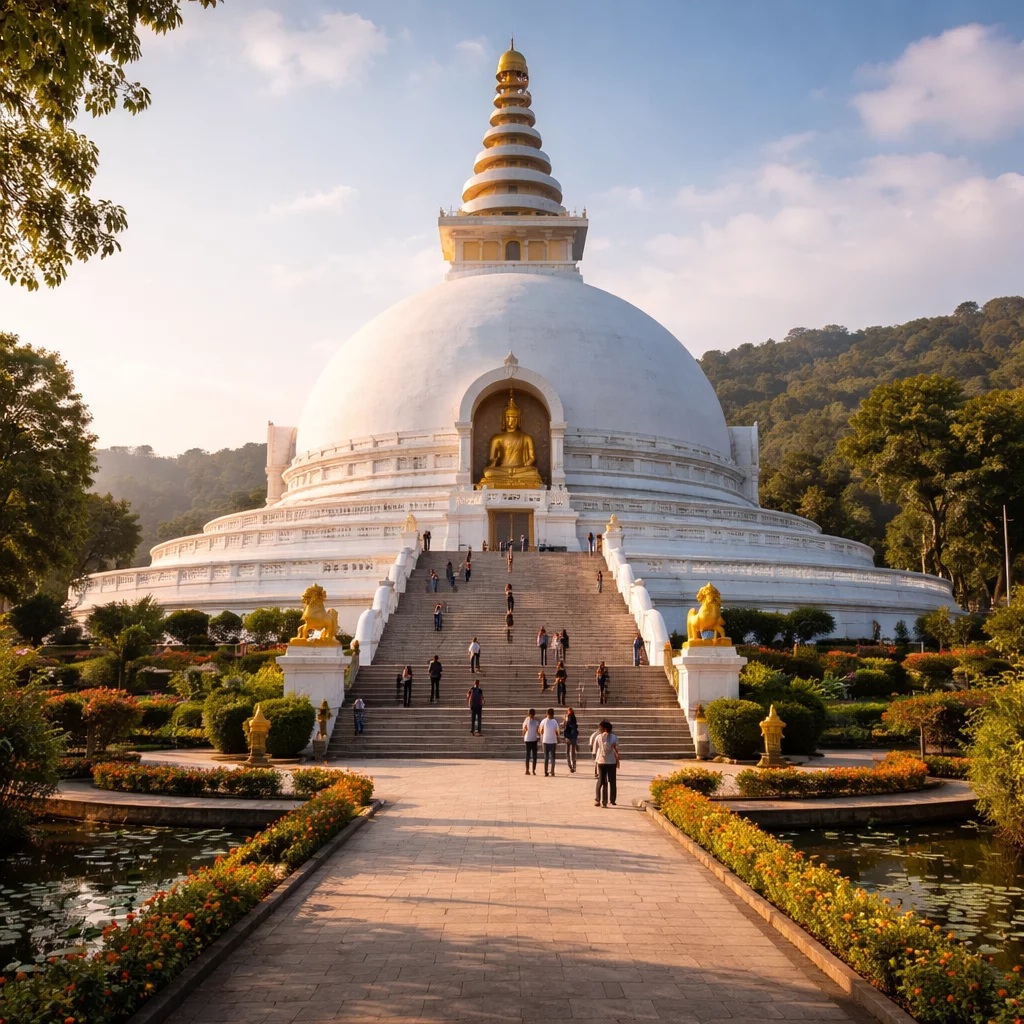
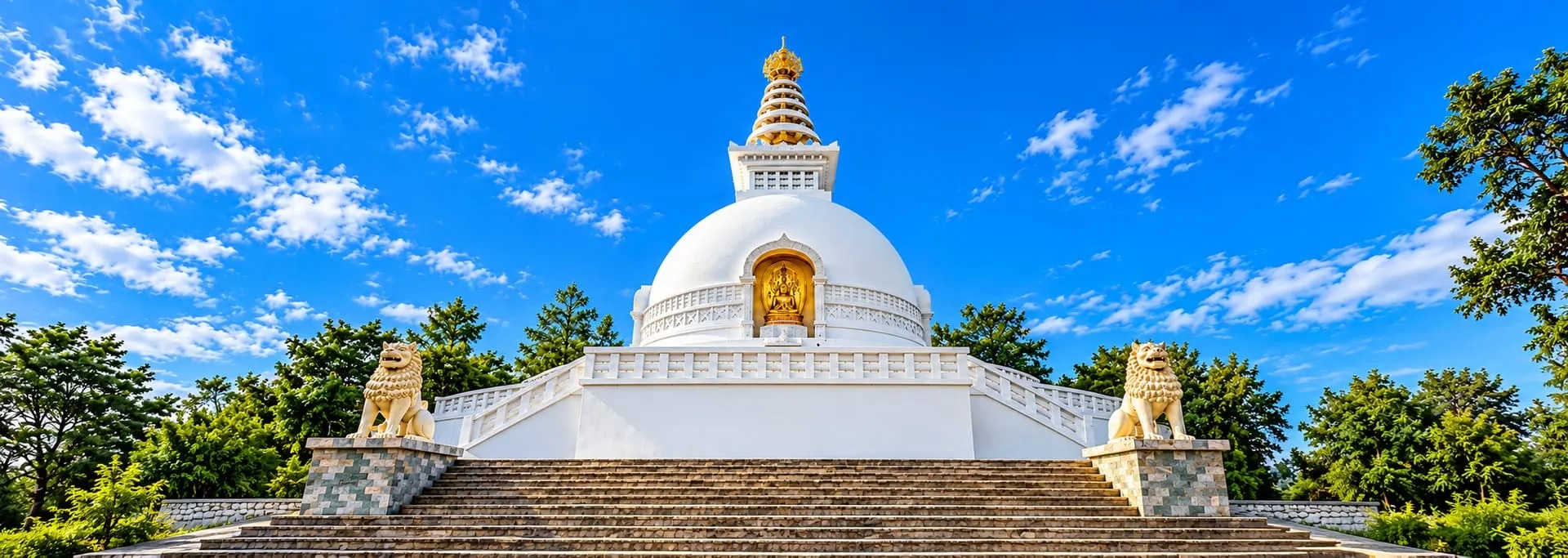
The architectural character of the Vishwa Shanti Stupa is defined by simplicity, symmetry and symbolism. Its white dome, circular composition and vertically rising spire follow the visual language traditionally associated with Buddhist stupas.
Unlike contemporary buildings that often communicate through complex geometries and elaborate façades, the monument achieves its identity through a relatively restrained architectural vocabulary.
The circular dome forms the central visual element. Above it, the ornamental spire rises vertically, creating a strong relationship between the horizontal mass of the structure and the vertical movement towards the sky.
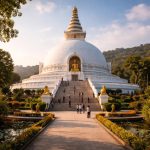
The use of white marble gives the monument a distinctive appearance. Against the surrounding green hills, the white structure becomes a visual landmark that can be recognised from a considerable distance.
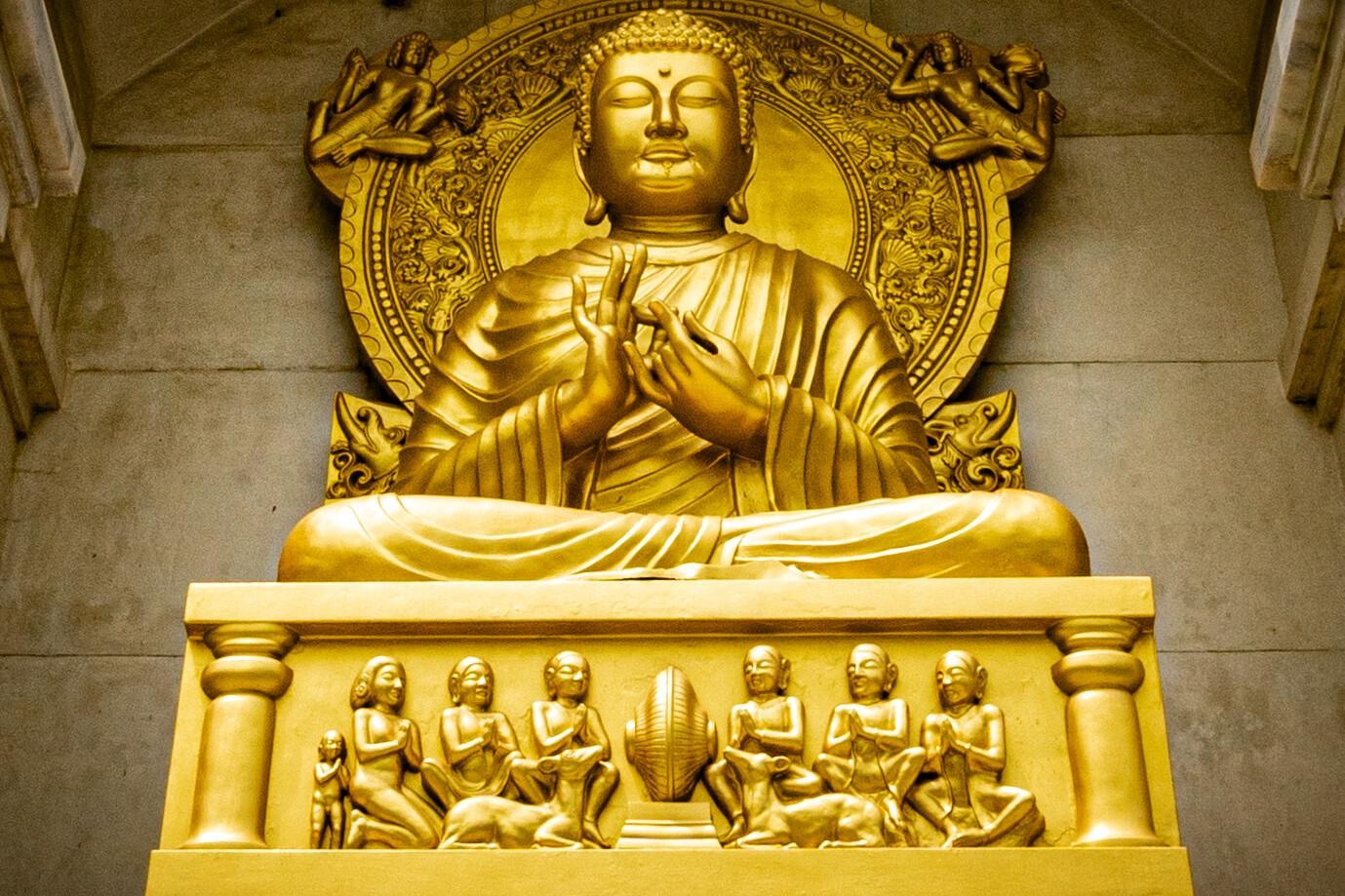
The golden sculptures provide contrast and introduce a layer of narrative into the architecture. They are not simply decorative elements; each represents an important chapter in the life of Gautama Buddha.
From an architectural perspective, the monument demonstrates how proportion, material, repetition and symbolism can work together to create a memorable landmark without relying on excessive ornamentation.
3. Four golden Buddha statues: Architecture as storytelling
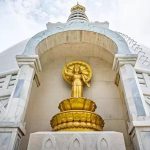
One of the most distinctive features of the stupa is the presence of four golden Buddha statues positioned around the central dome.
Each sculpture represents a significant event in the Buddha’s life:
- Birth: Symbolises the beginning of Siddhartha Gautama’s journey.
- Enlightenment: Represents his attainment of spiritual awakening.
- First preaching: Reflects his decision to share the teachings of Dharma with the world.
- Mahaparinirvana: Represents his final liberation and passing away.
The placement of these sculptures around the circular structure creates a visual sequence that can be experienced from different directions.
This approach is particularly meaningful because it transforms the building into a three-dimensional narrative. Visitors do not simply observe a religious monument; they encounter different stages of a spiritual journey through its sculptural composition.
The combination of gold and white also carries visual significance. The golden figures stand out against the marble surfaces, making the Buddhist imagery immediately visible and giving the monument its distinctive identity.
4. Material palette and construction character
Material selection plays an important role in the visual identity of the Vishwa Shanti Stupa.
The primary materials identified in official tourism descriptions are white marble and concrete. Their combination creates a monument that is visually substantial while maintaining the clean and luminous appearance associated with Buddhist sacred architecture.
Some noteworthy material and architectural characteristics include:
- White marble: Establishes the monument’s dominant visual identity and creates a sense of purity and serenity.
- Concrete: Forms part of the construction system supporting the monumental structure.
- Golden sculptures: Introduce colour, religious symbolism and visual emphasis.
- Circular terraces: Create a layered architectural composition around the central dome.
- Decorative railings and ornamental detailing: Reinforce the traditional Buddhist architectural character.
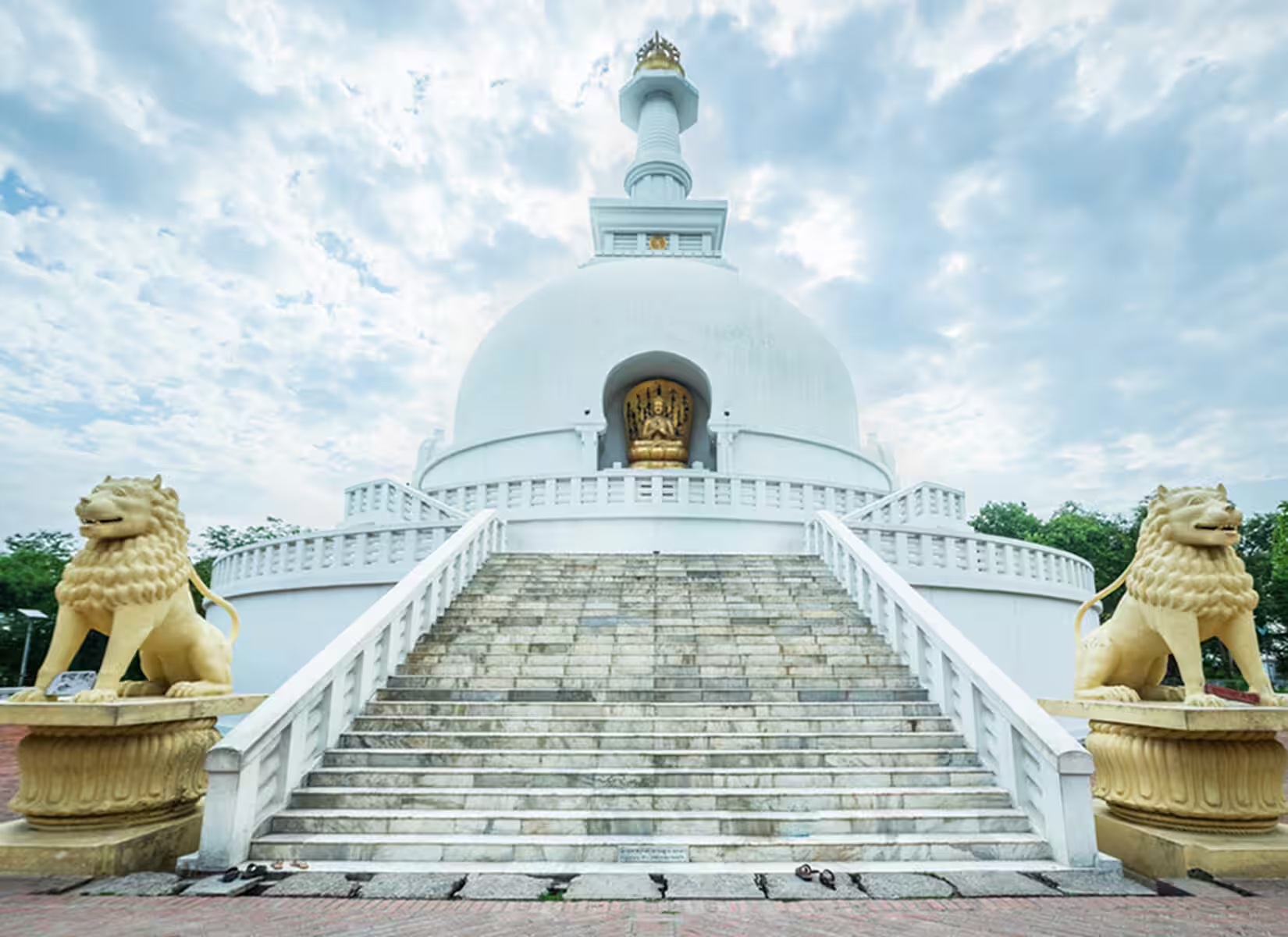
- Stepped access: Connects the surrounding landscape with the elevated sacred platform.
The material palette is relatively limited, yet its visual impact is considerable. The white surfaces reflect natural light, allowing the monument to appear different throughout the day as sunlight changes.
It is also worth noting that the stupa’s hilltop location contributes significantly to its architectural experience. The surrounding vegetation, open sky and distant landscape become part of the monument’s visual setting.
5. Landscape and site planning: Architecture in harmony with nature
The location of the Vishwa Shanti Stupa is one of its most compelling architectural features.
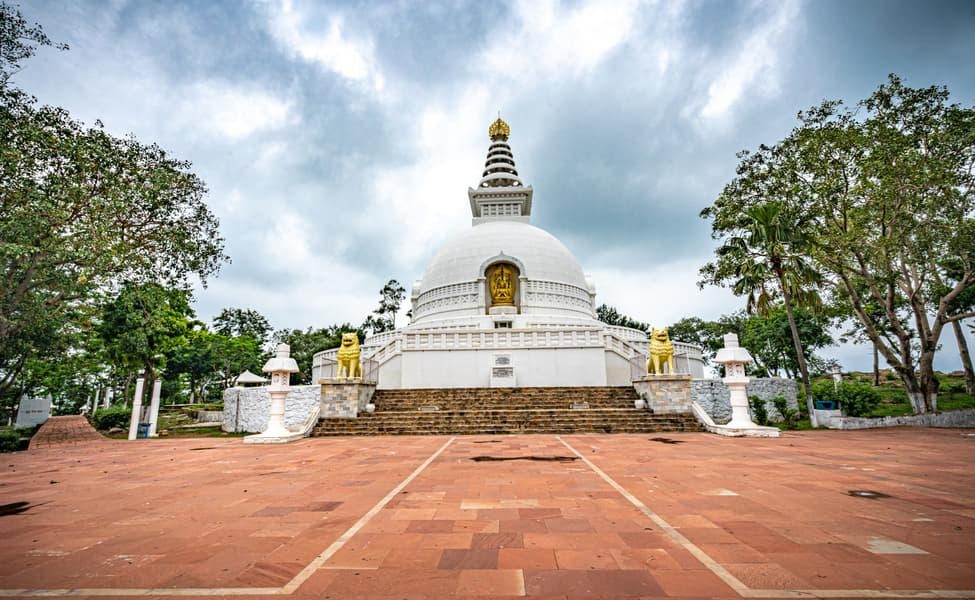
Situated atop Ratnagiri Hill, the monument occupies an elevated position overlooking the natural landscape of Rajgir. Rather than competing with its surroundings, the structure gains much of its presence from the relationship it establishes with the hills, forests and open sky.
The journey towards the stupa is an important part of the visitor experience. As visitors move upwards, the landscape gradually unfolds, creating a transition from the everyday environment of the town to a quieter spiritual setting.
This relationship between movement, elevation and architecture is particularly interesting from a landscape-planning perspective.
The hilltop setting offers several architectural experiences:
- A gradual visual revelation of the monument during the ascent.
- Panoramic views of Rajgir and the surrounding hills.
- An open setting that allows the stupa to be appreciated from multiple viewpoints.
- A quieter environment suited to reflection and meditation.
- A strong visual connection between the built monument and the natural landscape.
The setting demonstrates how site selection can be as important as the building itself when creating a spiritual landmark.
6. The ropeway: Connecting architecture with accessibility
An interesting aspect of visiting the Vishwa Shanti Stupa is the ropeway experience that connects the lower part of Ratnagiri Hill with the monument above.
The ropeway has become an attraction in its own right. It allows visitors to experience the surrounding landscape from an elevated perspective while making the hilltop destination more accessible.
The journey also creates an interesting contrast between traditional architecture and modern infrastructure. While the stupa represents centuries-old Buddhist architectural traditions, the ropeway introduces a contemporary mode of mobility into the visitor experience.
The Bihar State Tourism Development Corporation provides information about the ropeway, including its ticketing and operating arrangements.
For architects and urban planners, this relationship between heritage tourism, accessibility and landscape infrastructure is an interesting aspect of the overall destination.
7. Rajgir: A landscape of spiritual and architectural heritage
The importance of the Vishwa Shanti Stupa becomes even more apparent when viewed in the larger context of Rajgir’s historical and cultural landscape.
Known in ancient times as Rajagriha, Rajgir was an important centre during the Magadhan period. The region has strong associations with Gautama Buddha, Lord Mahavira and several important episodes in the history of Indian religious traditions.
The nearby Gridhakuta Hill, also known as Vulture Peak, holds particular importance in Buddhist history. It is associated with the Buddha’s teachings and meditation.
Other historically significant destinations include:
- Gridhakuta Hill: An important Buddhist pilgrimage site associated with Buddha’s teachings.
- Venu Van: A historic Buddhist site traditionally associated with King Bimbisara’s offering to Buddha.
- Cyclopean Wall: An impressive example of ancient stone construction surrounding old Rajgir.
- Ajatshatru Fort: An archaeological landmark associated with the history of Magadha.
- Nalanda Mahavihara: The remains of the celebrated ancient Buddhist monastic and educational institution.
Together, these places make Rajgir an important destination for understanding the relationship between religion, architecture, archaeology and cultural landscapes in India.
8. Architectural significance: Lessons for contemporary architects
The Vishwa Shanti Stupa offers several interesting observations for the contemporary architectural community.
1. Simplicity can create monumentality
The building does not depend on an excessively complicated form. Its circular geometry, dome and spire create a recognisable architectural identity through a relatively simple composition.
2. Symbolism can become an integral part of architecture
The four Buddha sculptures demonstrate how religious narratives can be incorporated into the physical design of a building.
3. Material and context can work together
The white marble surfaces create a strong visual contrast against the green surroundings. The result is an architectural landmark that feels connected to its natural environment.
4. Site selection influences architectural experience
The elevated location transforms the approach to the monument into an experience of gradual discovery, movement and contemplation.
5. Architecture can communicate universal values
Perhaps the most important lesson is that buildings can represent ideas that extend beyond their physical function. The Vishwa Shanti Stupa is not merely a place of worship; it is an international symbol of peace and human connection.
9. Why the Vishwa Shanti Stupa remains relevant today
In a world where architectural discussions frequently revolve around technology, sustainability, urbanisation and construction innovation, the Vishwa Shanti Stupa offers a different perspective.
It reminds us that architecture is also about creating spaces that influence human emotions and bring communities together.
Its historical connection with the peace movement, its Japanese Buddhist influence and its location in the culturally significant landscape of Rajgir make it an important example of architecture as a medium of cultural exchange.
The monument also demonstrates the enduring relevance of traditional architectural forms. Even after decades, its simple white silhouette continues to attract pilgrims, tourists, photographers, historians and architecture enthusiasts.
For India, the Vishwa Shanti Stupa is an important part of Bihar’s Buddhist heritage and an architectural landmark that connects the country’s ancient spiritual traditions with an international vision of peace.
Conclusion: A monument that speaks the language of peace
The Vishwa Shanti Stupa in Rajgir stands as a remarkable example of how architecture can communicate values that are universal and timeless.
Its white marble structure, golden Buddha sculptures, Japanese Buddhist influence and elevated natural setting come together to create an environment that encourages reflection and spiritual connection.
More than five decades after its inauguration, the monument continues to represent the idea that peace is not simply a political aspiration or religious philosophy; it is a shared responsibility of humanity.
For the architectural community, it offers an enduring lesson: the most meaningful buildings are not always those that make the boldest statements through their form, but those that leave a lasting impression through the values they represent.